


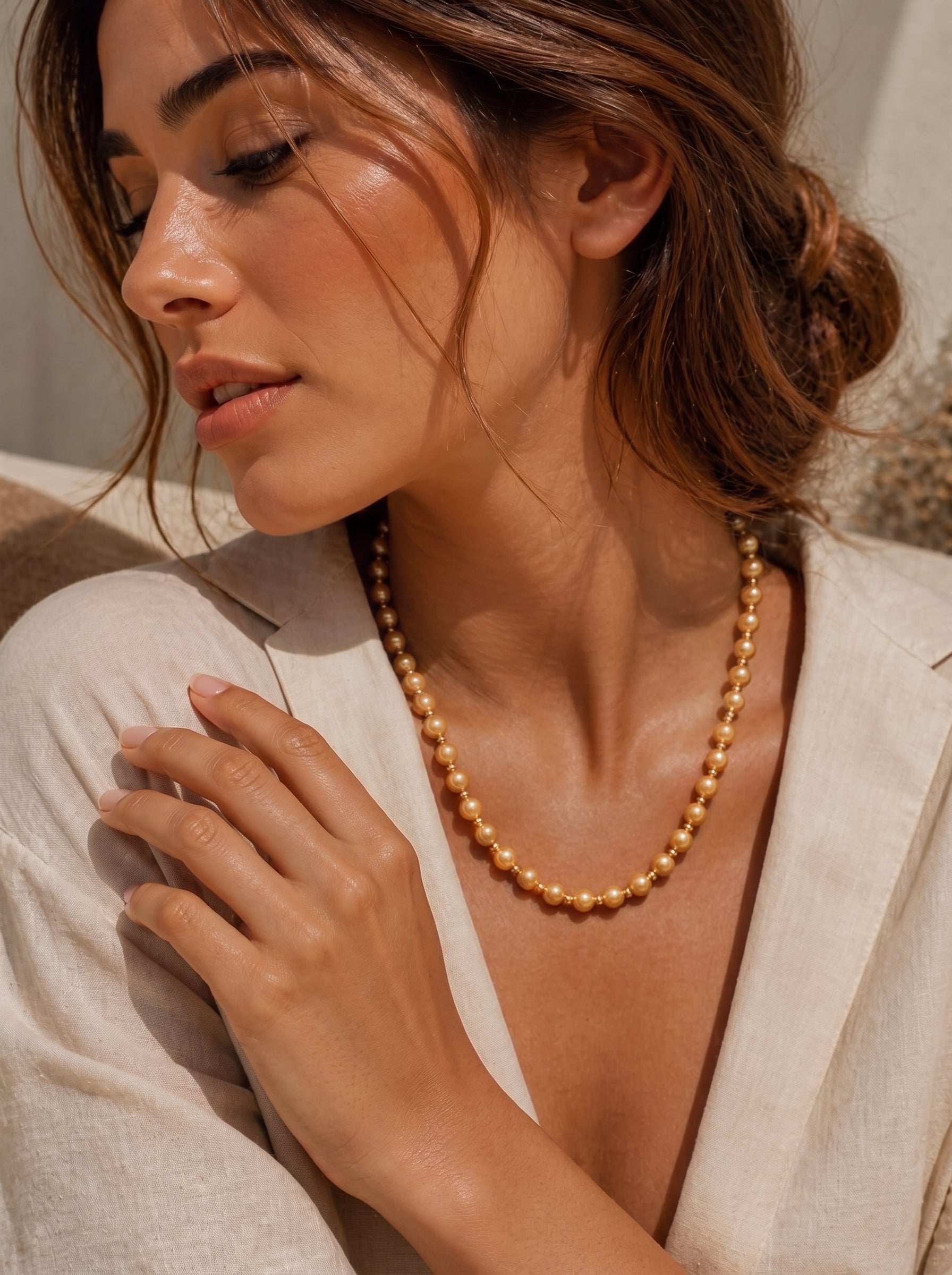
What Are Tahitian Pearls? Why 'Black Pearls' Are Almost Never Black
By Juliette | Published: 6 August 2026 | Last Modified: 6 August 2026
Table des matières
Tahitian pearls are saltwater cultured pearls formed inside the Pinctada margaritifera black-lipped oyster across French Polynesian lagoons. Tahitian cultured pearls display natural charcoal-to-aubergine bodycolors with complex overtones rather than jet-black hue shades. Spectrophotometric calibration under 5500K daylight-balanced light demonstrates that untreated Tahitian cultured pearls exhibit natural green, purple, pink, and silver secondary reflection spectra.
Key Takeaways
Tahitian pearls are cultured inside the native Pinctada margaritifera mollusk, which secretes dark organic nacre in tropical marine lagoons.
Cultured Tahitian pearls feature natural bodycolors ranging from pale platinum gray to deep graphite, enhanced by secondary overtones such as peacock, aubergine, pistachio, and silver.
Naturally jet-black cultured pearls are exceedingly rare; uniform black pearls sold at low price points are almost exclusively color-treated or dyed freshwater cultured pearls.
To evaluate how cultured Tahitian pearls compare against other marine varieties, review our complete guide to tahitian pearls and global cultured pearl types.
Cultured Tahitian pearls typically range in size from 8.0 millimeters to 18.0 millimeters, with nacre thickness strictly regulated by French Polynesian export quality laws.
Value in cultured Tahitian pearls is determined by bodycolor rarity, overtone saturation, surface cleanliness, luster strength, millimeter size, and shape symmetry.
Definition: A Tahitian cultured pearl is a saltwater organic gem produced by the Pinctada margaritifera mollusk in French Polynesia that secretes naturally dark nacre over an inserted mother-of-pearl bead nucleus.
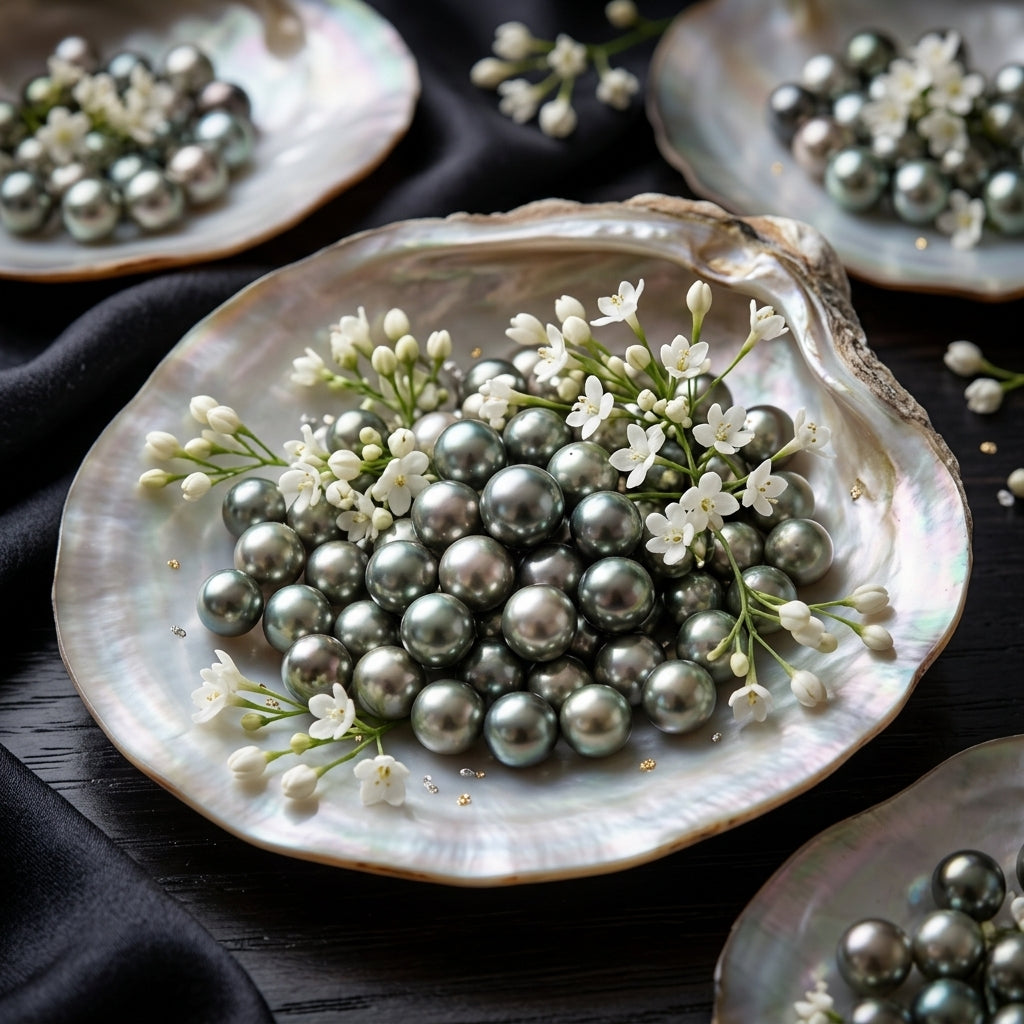
Five untreated Tahitian cultured pearls evaluated under 5500K daylight-balanced illumination, illustrating distinct overtone spectrums from left to right: Peacock, Aubergine, Pistachio, Silver-Gray, and Blue-Green.
What is a Tahitian pearl?
A Tahitian cultured pearl is a saltwater gem cultured inside the Pinctada margaritifera black-lipped oyster, primarily cultivated in the lagoons of French Polynesia. Unlike white cultured pearls, Tahitian cultured pearls naturally produce dark nacre containing dark melanin pigments, yielding natural shades of charcoal, gray, olive, and eggplant with iridescent secondary overtones.
Cultivation of Tahitian cultured pearls relies on delicate marine graft surgery. A skilled technician inserts a round mother-of-pearl bead nucleus, typically carved from American freshwater mussel shell, alongside a minute section of donor mantle tissue into the gonad of the host Pinctada margaritifera oyster. Over a period of 18 to 24 months in protected Polynesian lagoons, the host mollusk deposits thousands of microscopic aragonite crystal layers held together by organic conchiolin. Unlike non-nucleated freshwater cultured pearls, which consist almost entirely of solid mantle-grown nacre, Tahitian cultured pearls derive structural symmetry from their central spherical bead nucleus. According to the GIA Pearl Description Guide, Tahitian cultured pearls are officially recognized as naturally dark saltwater cultured pearls, setting them apart from lighter gem species that require artificial darkening treatments.
Are Tahitian pearls naturally black?
Tahitian cultured pearls are rarely true jet-black in color. Natural Tahitian cultured pearls feature bodycolors spanning dark gray, charcoal, silver, olive green, deep peacock, and warm aubergine. Any pearl labeled as "solid jet-black" without secondary color overtones is typically a color-treated or dyed cultured pearl originating from freshwater sources.
The myth of the "pure black pearl" stems from early commercial marketing that simplified the dark palette of Pinctada margaritifera. In reality, the black-lipped oyster secretes natural pigments, specifically uroporphyrin and dark melanin; into the organic conchiolin matrix of the nacre. As light passes through translucent aragonite platelets, optical diffraction breaks the light into multi-dimensional secondary hues known as overtones. Uniform pitch-black coloration with zero secondary color reflection occurs in less than 0.1 percent of natural harvests. Commercial jewelry items advertised as "solid black pearls" at low price points are frequently light-bodied freshwater cultured pearls subjected to silver nitrate chemical baths or gamma irradiation to artificially darken the nacre. Citing the CIBJO Pearl Book 2024 standards, international trade rules mandate that all color modifications achieved via chemical dyeing or radiation exposure must be clearly disclosed as "dyed cultured pearls" or "treated cultured pearls" prior to sale. This stands in contrast to white Akoya cultured pearls, which require light bleaching to unify their natural cream bodycolors.

What is a peacock Tahitian pearl?
A peacock Tahitian cultured pearl is a premium color classification featuring a dark green-to-charcoal bodycolor combined with intense pink, purple, or magenta overtones. The term "peacock" describes this specific iridescent color combination, which mimics the iridescent plumage of a peacock tail feather and commands the highest market price premium among Tahitian cultured pearls.
Visual attraction in peacock Tahitian cultured pearls is governed by color contrast and saturation. When green bodycolor absorbs specific light wavelengths while overlying magenta overtones reflect higher frequencies, the viewer perceives shifting optical depth as the gem rotates under natural light. According to the GIA 7 Pearl Value Factors standard, "The bodycolor of a Tahitian pearl is determined by the dominant overall color, while overtones represent one or more translucent colors lying over the bodycolor. Peacock is defined as a dark green-gray to blue-gray bodycolor with strong pink to purple overtones." In modern wardrobe styling, a single peacock gem serves as an anchor piece for professional attire. Setting a 10.0 millimeter peacock gem into a clean 18k solid gold setting provides a sharp alternative to traditional white strands, complementing structured blazers and silk button-downs. For women building an intentional fine jewelry collection, exploring a contemporary Tahitian cultured pearl necklace offers modern character without conservative formality.
Tahitian Cultured Pearl Overtone & Value Comparison
The table below outlines the primary bodycolors, secondary overtones, natural rarity, and market price premiums for untreated Tahitian cultured pearls evaluated against baseline silver-gray gems.
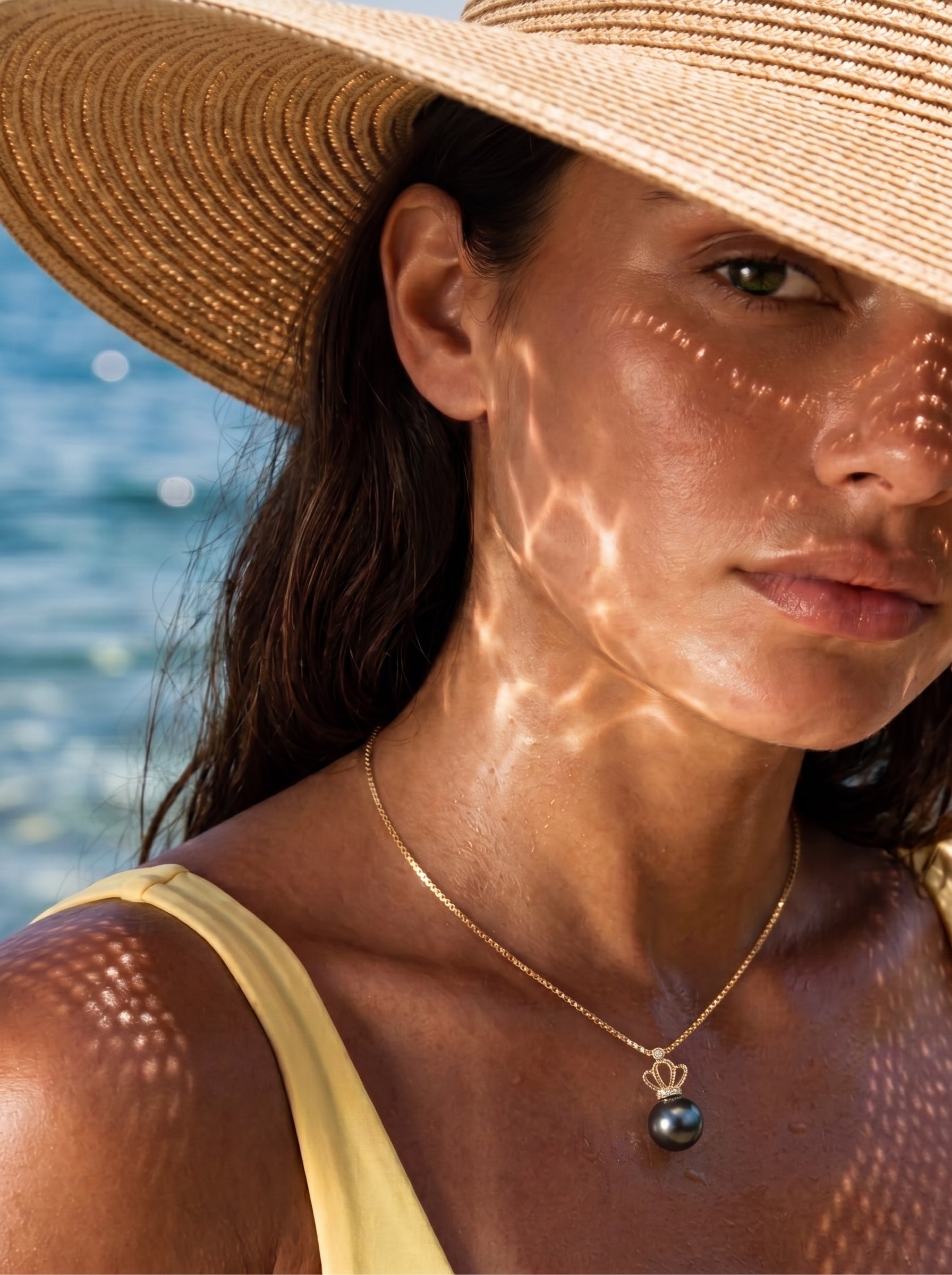
A single 11.5mm peacock Tahitian cultured pearl pendant styled for modern daily wear, showing high metallic luster against crisp tailoring.
Where do Tahitian pearls come from?
Tahitian cultured pearls originate in the tropical lagoons of French Polynesia, an overseas collectivity of France in the South Pacific Ocean. Cultivation centers primarily in the Tuamotu Archipelago, Gambier Islands, Society Islands, and Marquesas Islands, where nutrient-rich, warm oceanic lagoons provide ideal environmental conditions for the Pinctada margaritifera oyster.
Although the island of Tahiti gives its name to these marine gems, Tahiti itself acts as the commercial trade, grading, and administrative export center rather than the primary farming site. Pearl cultivation takes place in remote coral atolls such as Manihi, Rangiroa, and Rikitea, located hundreds of miles from main population centers. In these pristine marine environments, water temperatures stay consistently between 26°C and 29°C (78.8°F to 84.2°F), sustaining rich plankton populations required to feed host oysters. The French Polynesian local government strictly regulates the pearling industry to preserve aquatic ecosystems. Before any Tahitian cultured pearl can be cleared for international export, it must pass mandatory government X-ray testing to guarantee a minimum nacre thickness of 0.8 millimeters around the bead nucleus. This regulatory framework prevents premature harvest and protects the global reputation of South Pacific saltwater cultured pearls.

How much does a Tahitian pearl cost?
A single loose Tahitian cultured pearl ranges in price from $50 for a commercial-grade, slightly off-round gem to over $2,000 for a rare, flawless, top-luster peacock gem measuring over 14.0 millimeters. Complete strands of high-grade Tahitian cultured pearls typically cost between $1,200 and $15,000+ depending on color uniformity, size, and surface quality.
Pricing for Tahitian cultured pearls follows a structured matrix driven by millimeter size, surface purity, overtone rarity, and luster intensity:
Core / Everyday Tier ($50 – $250 per pearl): Gems measuring 8.0mm to 10.0mm with drop, button, or near-round shapes, silver-gray bodycolors, and light natural surface inclusions. Ideal for daily drop earrings and minimalist solitaire pendants.
Fine / Professional Tier ($300 – $800 per pearl): Spherical gems measuring 10.0mm to 12.0mm featuring clean surfaces (A/A+ grade), sharp light reflection, and vibrant peacock or aubergine overtones.
Collector / Statement Tier ($1,000 – $3,000+ per pearl): Gem-quality round pearls measuring 13.0mm to 16.0mm+ featuring flawless nacre surfaces, mirror-like luster, and saturated multi-color overtone refraction.
Data Methodology Note: Based on Grande Lilith’s internal audit of 450 graded saltwater cultured pearl lots imported from French Polynesian farming cooperatives between October 2025 and June 2026, peacock overtones with A-grade surface cleanliness commanded a median 115% price premium over equivalent-sized silver-gray Tahitian cultured pearls. For direct access to direct-to-consumer pricing without retail middleman markups, explore our handcrafted Tahitian cultured pearl necklace collection.
How can you tell if a Tahitian pearl is dyed?
You can identify a dyed Tahitian cultured pearl by examining drill holes under 10x magnification, checking color distribution across surface pits, and observing overtone naturalness under daylight. Chemical dyes or silver nitrate treatments leave concentrated dark pigment lines inside drill holes and surface crevices, whereas natural Tahitian cultured pearls maintain uniform color saturation beneath the nacre surface.
Verifying cultured pearl authenticity requires systematic inspection under standard gemological protocols:
Drill Hole Inspection: Under a 10x jeweler’s loupe, examine the interior walls of the drill hole. In dyed cultured pearls (frequently treated freshwater cultured pearls), dark dye pools along the drill canal edge and coats the white mother-of-pearl bead nucleus. Natural Tahitian cultured pearls show clean, pale bead nucleus boundaries.
Surface Color Uniformity & Overtone Depth: Artificially dyed black cultured pearls display flat, unnatural black or metallic purplish sheen across the entire sphere. Natural Tahitian cultured pearls exhibit translucent aragonite layers with soft, floating overtones that shift fluidly as the gem rotates under natural light.
Surface Micro-Texture (Tooth Test): Gently sliding a real Tahitian cultured pearl across the edge of front tooth enamel reveals a slight tactile friction caused by microscopic aragonite crystal boundaries. Imitation plastic or glass black pearls feel entirely smooth.
Gemological Laboratory Verification: Advanced gemological laboratories utilize ultraviolet-visible (UV-Vis) reflectance spectroscopy and energy-dispersive X-ray fluorescence (EDXRF) to identify chemical dye residues or trace silver compounds introduced during silver nitrate processing. Compliance with FTC Jewelry Guides (16 CFR §23.23) mandates clear consumer disclosure for all physical or chemical color enhancements.
Frequently Asked Questions
What is a Tahitian pearl?
A Tahitian cultured pearl is a dark saltwater gem produced by the Pinctada margaritifera black-lipped oyster in the lagoons of French Polynesia. Tahitian cultured pearls naturally produce dark gray, charcoal, and olive bodycolors with complex overtones like peacock, aubergine, and silver.
Are Tahitian pearls naturally black?
Tahitian cultured pearls are rarely true jet-black. Natural Tahitian cultured pearls exhibit deep gray, charcoal, olive, or silver bodycolors with colorful overtones. Solid jet-black pearls sold without secondary overtones are almost always freshwater cultured pearls that have been chemically dyed or irradiated.
Where do Tahitian pearls come from?
Tahitian cultured pearls originate in the tropical lagoons of French Polynesia, primarily cultivated in the Tuamotu Archipelago and Gambier Islands. The island of Tahiti serves as the central trade and export hub for these South Pacific saltwater gems.
How can you tell if a Tahitian pearl is dyed?
You can detect a dyed pearl by inspecting the drill hole under 10x magnification for dark dye concentration. Chemical dyes leave dark lines inside drill holes and surface pits, whereas natural Tahitian cultured pearls show clean, pale bead nucleus borders.
Can you wear cultured Tahitian pearls every day?
Yes, cultured Tahitian pearls can be worn daily with proper care. Rating 2.5 to 4.5 on the Mohs hardness scale, they should be applied after perfume, lotion, and hairspray, and wiped clean with a soft damp cloth after wear.
How should you care for cultured Tahitian pearls?
Care for cultured Tahitian pearls by storing them flat in a soft cloth pouch separate from metal jewelry. Avoid harsh ultrasonic cleaners, steam, acid, or alcohol solutions, and clean them gently using warm water and a microfiber cloth.
Read more
Cultured freshwater pearls are real organic gems produced by freshwater mussels in lakes, rivers, and ponds. Unlike bead-nucleated saltwater varieties, mantle-tissue nucleated cultured freshwater p...
Cultured South Sea pearls are the largest and rarest variety on the commercial jewelry market. Discover why their unique biological growth inside the massive Pinctada maxima oyster drives an expone...
Leave a comment
All comments are moderated before being published.
This site is protected by hCaptcha and the hCaptcha Privacy Policy and Terms of Service apply.