



Mother of pearl bracelet
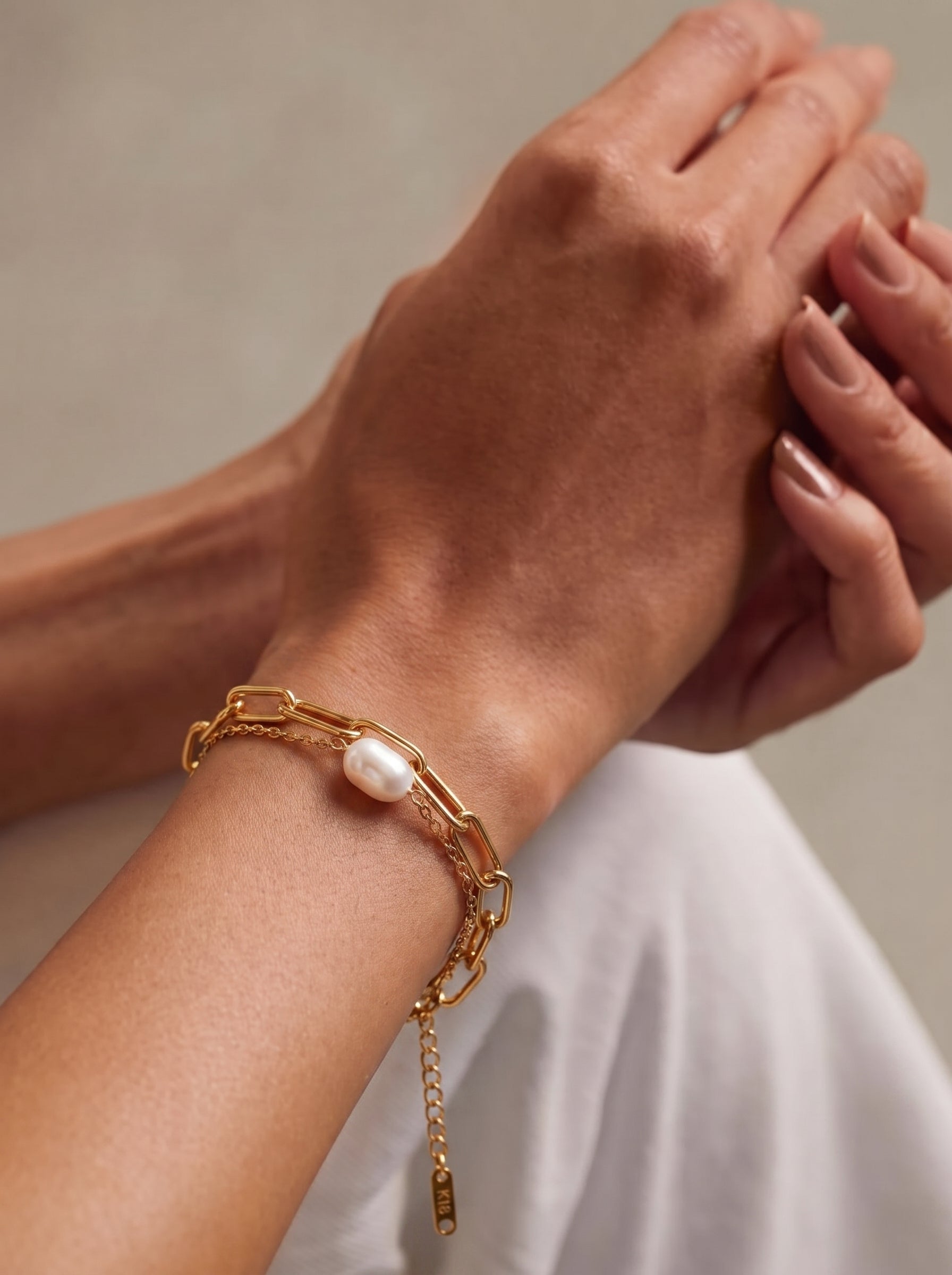
Flat polished discs of shell, beaded close along the wrist. Lighter than a strung pearl bracelet, and easier to stack — with a watch, with a chain, with three of its own. Soft iridescence that moves as your hand does.
Sort by
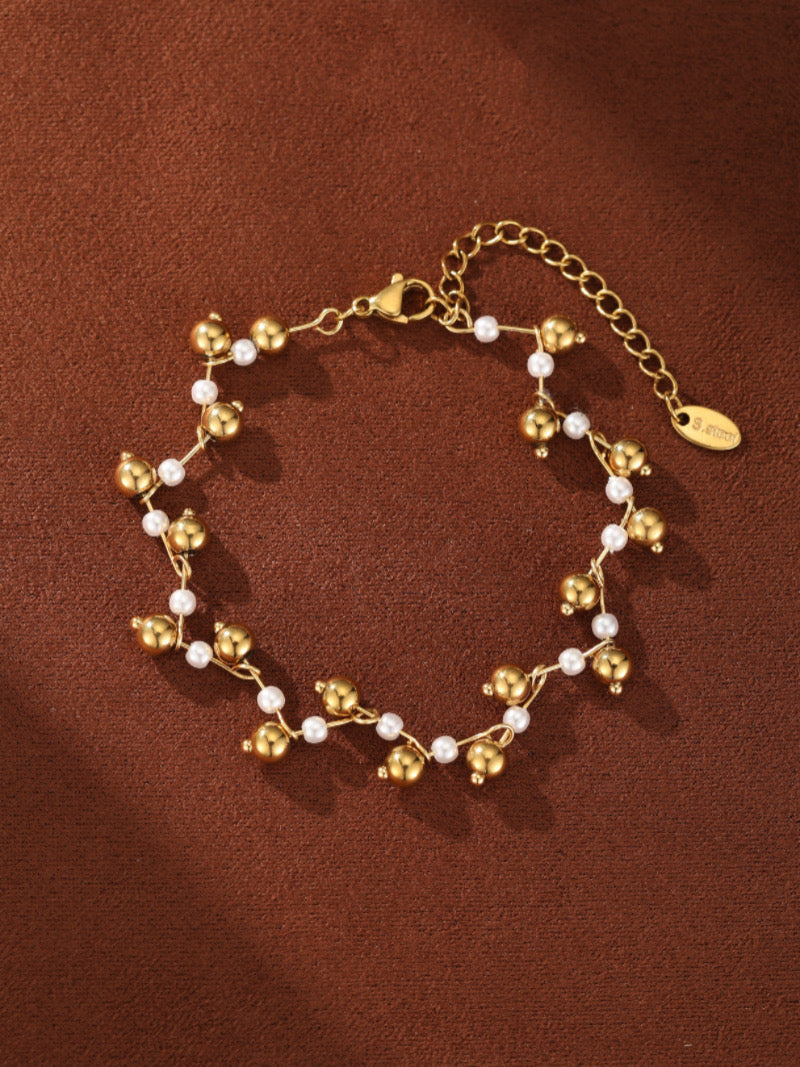
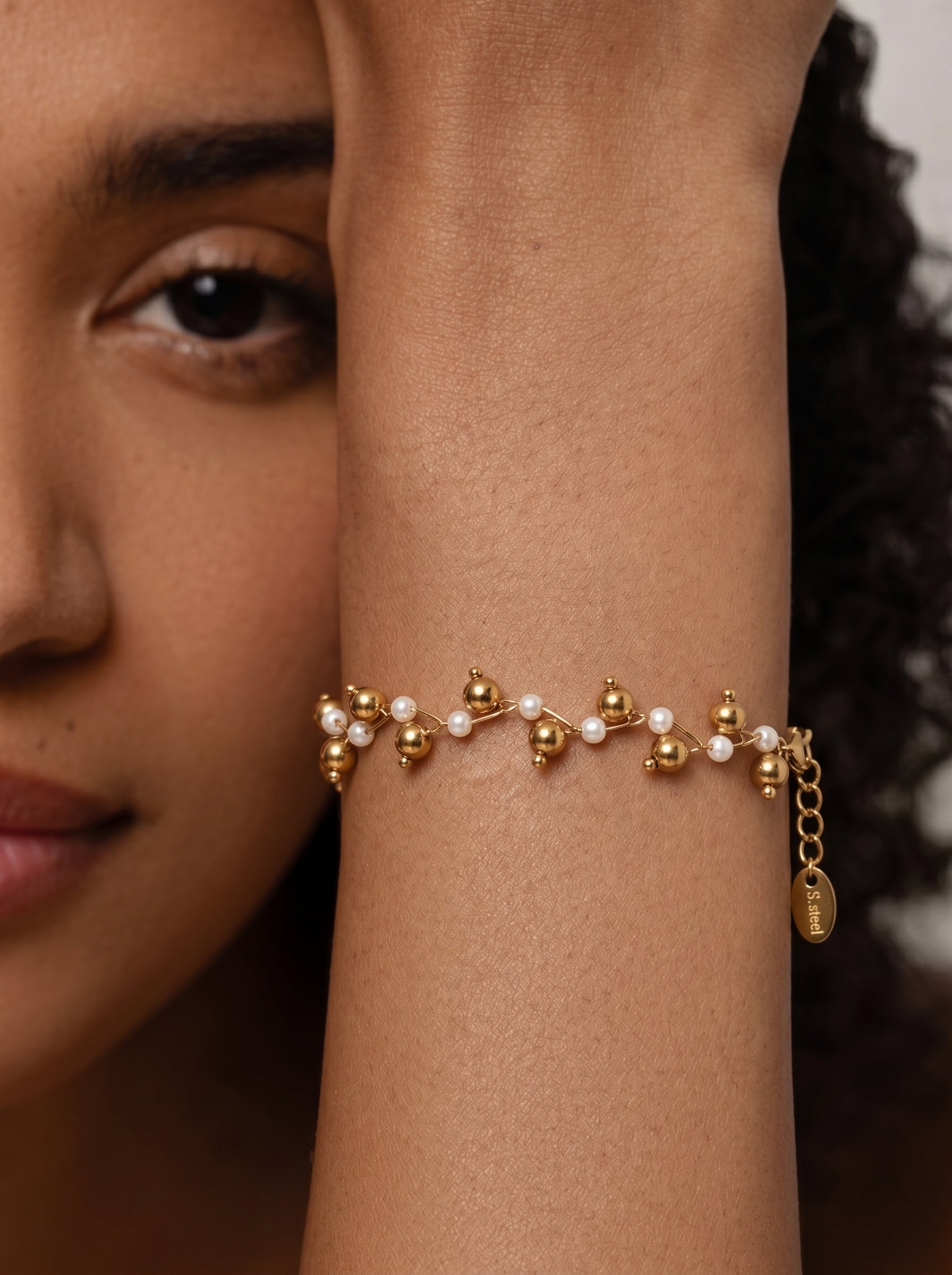
Mother of pearl bracelet
Mother of pearl weighs less than a strung pearl strand and stacks more easily because of it. Flat polished discs of shell sit close against the wrist, sliding under a sleeve without the bulk of a round bead.
What is mother of pearl?
Mother of pearl is the iridescent inner lining of a mollusk shell. It is nacre, the identical material a pearl is made of, laid down by the same animal for the same purpose: to line the inside of its own shell smoothly.
The difference from a pearl is formation, not substance. A pearl forms as a free body inside the mollusk. Mother of pearl forms as a sheet against the shell wall, and is then cut and polished into shape.
Why does mother of pearl suit a bracelet?
Weight and profile. Shell cut into flat discs weighs a fraction of what an equivalent strand of round pearls does, and it lies close against the wrist instead of standing off it.
That matters for stacking. Three flat-disc bracelets sit comfortably where two beaded strands already feel like too much, and none of them will roll under a shirt cuff.
Which mother of pearl bracelet style should you choose?
Disc strands
Flat rounds strung close together, catching light across a wide face rather than in a point. The most versatile version and the easiest to layer.
Shell and shape charms
Shells, stars and petals cut from the sheet and threaded alongside beads. Shell can take shapes a round pearl cannot, which is why the motif work in this material is so much broader.
Mixed with pearls
Shell discs alongside cultured pearls, which is the same material in its two natural states. The contrast between flat and round gives texture without introducing a second material at all.
How should a pearl bracelet fit?
With about half an inch of room past your wrist measurement. Loose enough to rotate, close enough that it does not slide over the hand. Measure just below the wrist bone. Flat discs take up less circumference than round beads, so a shell bracelet can sit closer than a beaded one at the same length.
Why buy a mother of pearl bracelet from Grande Lilith
Mother of pearl is frequently sold with vague descriptions, sometimes implied to be pearl and sometimes confused with resin or plastic imitations that mimic the same iridescence.
- Material named accurately. Mother of pearl is described as mother of pearl, never as pearl.
- Eight provenance markers on every product page, so you know exactly what you are buying.
- Partners vetted by our GIA-certified pearl specialist, on working conditions as well as quality.
- Nickel-free, lead-free and cadmium-free clasps and findings on gold, silver and stainless steel.
- Designed in Paris. Thirty days to change your mind, and every order arrives in a magnetic pouch.
Frequently asked questions
Is mother of pearl real?
Yes. It is natural nacre produced by a living mollusk, the same substance a pearl is made of. It is not a synthetic, a resin or a coating, though imitations of all three exist and are sold under similar names.
How can you tell real mother of pearl from plastic?
Real mother of pearl feels cool and stays cool for a moment in the hand. Its iridescence varies across the surface, since it follows the natural growth lines of the shell. Plastic warms quickly and repeats the same pattern uniformly.
Does mother of pearl scratch on a wrist?
It can, since it is soft and the wrist takes constant contact with desks and sleeves. A flat disc is actually more resilient than a round bead here, because it presents no high point to catch.
Can you wear a mother of pearl bracelet every day?
Yes. Take it off before washing dishes or applying hand cream, and wipe it with a soft damp cloth afterwards. Never use an ultrasonic cleaner, which separates the nacre layers.
Why is mother of pearl less expensive than pearls?
Because the shell is harvested as a by-product of pearl farming and food production rather than grown as a single gem over years. You are paying for cutting and polishing, not for the wait.