

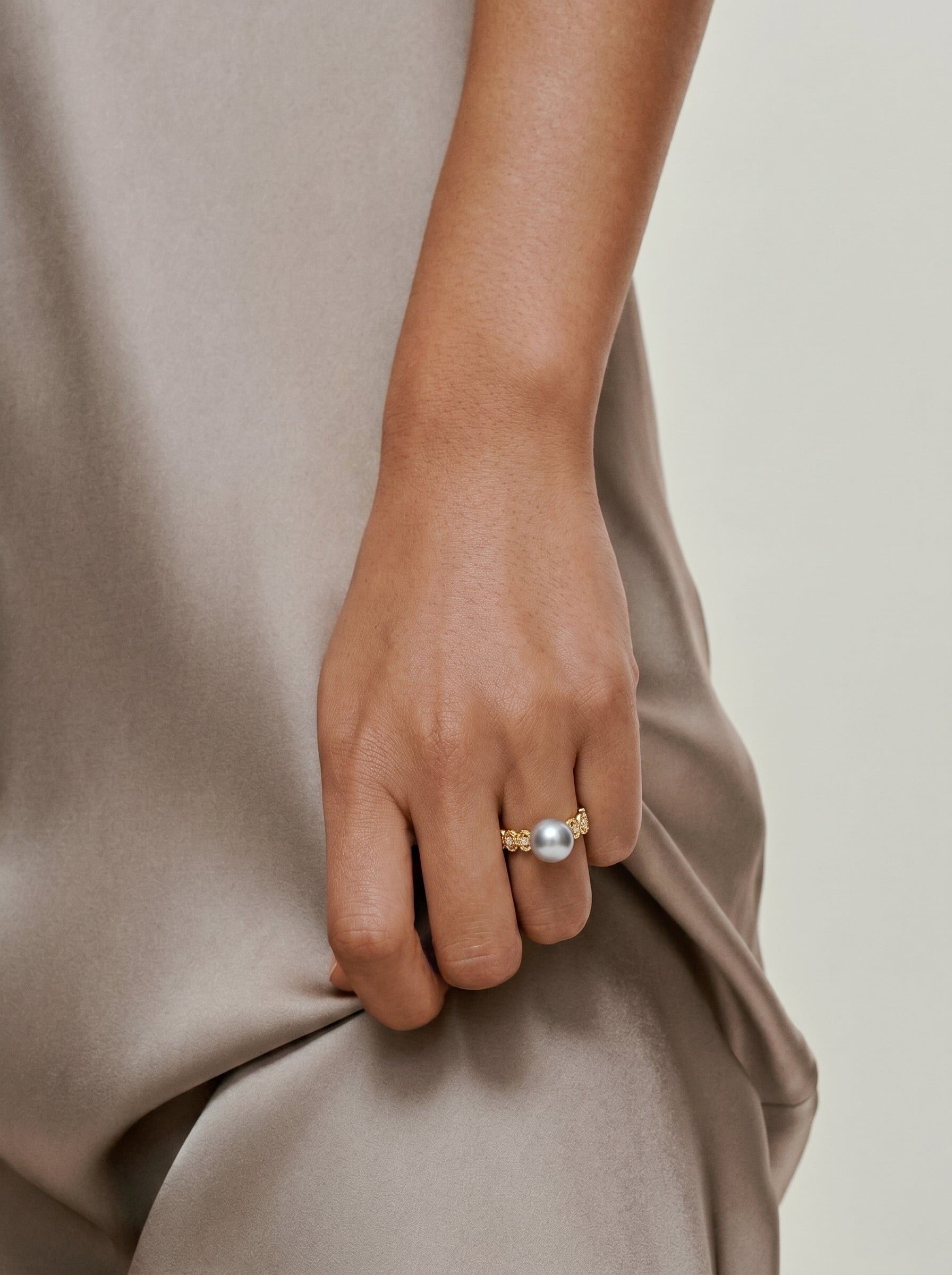


Akoya pearl ring
A single round Akoya pearl, set clean on a band. Nothing decorative around it, because it does not need anything. This is the pearl ring people picture — the one that reads as a choice rather than a gift.
This collection is empty
Akoya pearl ring
A round Akoya pearl set clean on a band, with nothing around it. This is the pearl ring people picture, and the one that reads as a decision rather than as a gift.
What is an Akoya pearl ring?
An Akoya pearl ring sets a saltwater cultured pearl grown in Pinctada fucata martensii, the Akoya oyster, primarily in Japan. Each pearl grows around a round shell bead, which is why Akoya pearls are consistently spherical in a way freshwater pearls rarely are.
On a ring, that roundness matters because a single pearl is examined more closely than any pearl in a strand. There is nothing beside it to distract from its shape.
Why does a ring show Akoya luster so clearly?
Because a hand moves constantly and at close range. Akoya nacre is thin and densely layered over a shell bead, which reflects light back in an almost mirror-like way, and that sharpness registers most when the pearl is close to the eye.
It also means you can go a size smaller here than you would with another pearl type and still be seen.
Does thin nacre matter on a ring?
More than anywhere else, and this is worth knowing before you buy. Akoya nacre is thinner than freshwater nacre because the pearl is a layer over a bead rather than solid nacre throughout.
A ring takes more abrasion than any other piece of jewelry. That does not rule out an Akoya ring, but it does mean choosing a low setting and taking it off before anything involving hands and water.
How should an Akoya ring be set and sized?
Low. Pearls rank 2.5 to 3 on the Mohs hardness scale, softer than almost anything else in a jewelry box, so a raised setting takes more impact than nacre comfortably absorbs.
Most pearl rings cannot be resized after purchase, because the heat and solder used in resizing damage nacre. Check the size guide before ordering, and measure at the end of the day when fingers are largest.
Why buy an Akoya pearl ring from Grande Lilith
Akoya is the category where a buyer is most likely to be paying for a name rather than a pearl, because the term is used loosely for pearls grown well outside Japan.
- Origin named: Japan. Not "Akoya-type" or "Akoya-style", terms used elsewhere for pearls grown in other waters.
- Eight provenance markers on every product page, including grade and treatment.
- Partners vetted by our GIA-certified pearl specialist, on working conditions as well as quality.
- Settings kept low so the ring clears daily life, and nickel-free, lead-free and cadmium-free throughout.
- Designed in Paris. Thirty days to change your mind, and every order arrives in a magnetic pouch.
Frequently asked questions
Can you wear an Akoya pearl ring every day?
Yes, with a little more care than a freshwater ring. Take it off before hand washing, cleaning and lotion, and store it away from harder stones. Thin nacre means abrasion matters more here than with a solid-nacre pearl.
What size Akoya pearl suits a ring?
Between 7 and 9 mm. Akoya pearls rarely exceed 9 mm because the host oyster is small, and at that size the pearl reads clearly on a hand without becoming something you have to work around.
Can an Akoya pearl ring be resized?
Usually not, because resizing requires heat and solder and both damage nacre. Check the size guide before ordering, or choose an adjustable open cuff style if you are between sizes.
Are Akoya pearls always white?
Standard Akoya bodycolor is white or cream, with rose, silver or ivory overtone. Nearly all Akoya on the market is bleached and polished as accepted industry practice, and we state that treatment on every product page.
Is an Akoya ring suitable for engagement?
Pearls are softer than diamonds or sapphires, and Akoya nacre is thinner than most. A ring worn daily for decades will show wear a harder stone would not. Many people choose one anyway and keep it for occasions. It is a preference, not a mistake.