



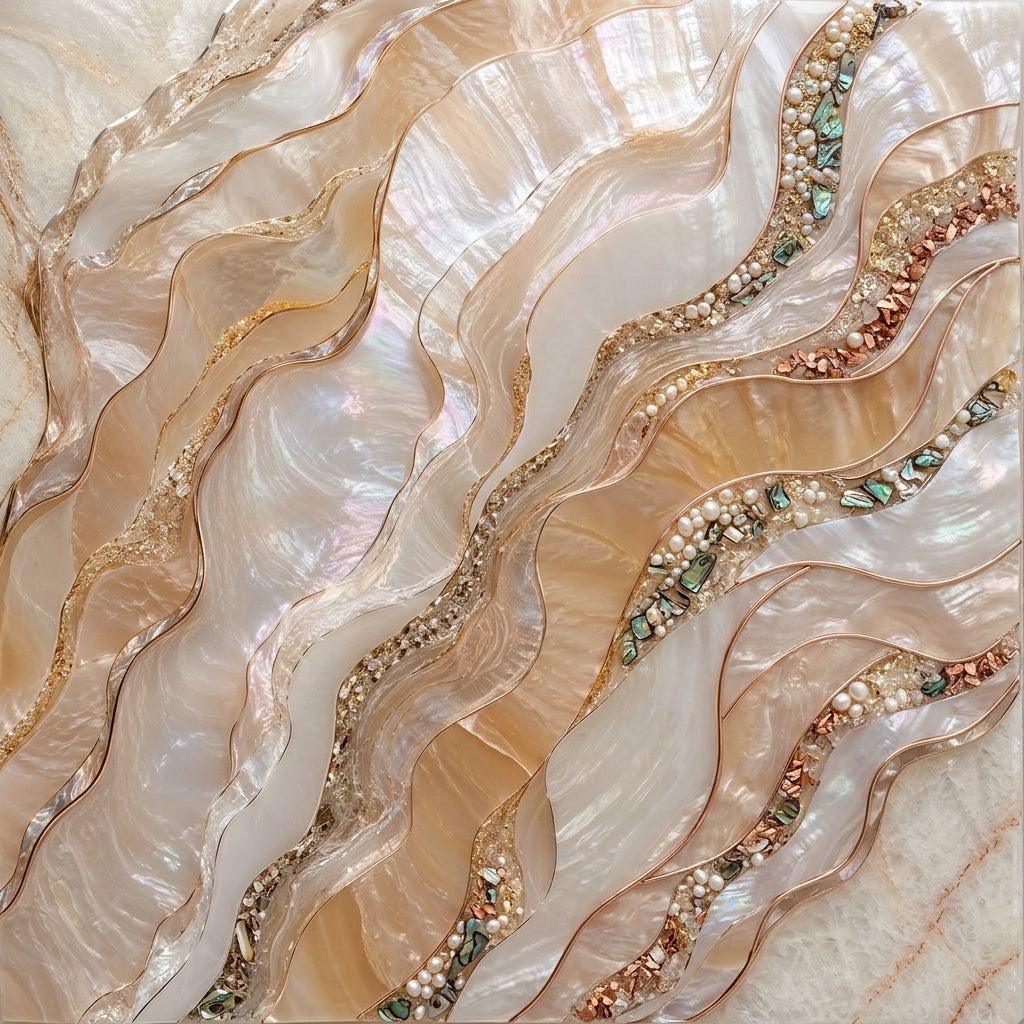
Mother of Pearl Nacre: Why Thickness Decides How Long Pearls Last
Table des matières
Mother of pearl nacre is the organic-inorganic composite material secreted by mollusks that forms the iridescent outer layers of a cultured pearl. Nacre thickness directly determines the structural lifespan, surface durability, and deep optical luster of cultured pearls. Macro-measurement of bead-nucleated cultured pearls shows that a 0.20 mm nacre layer wears through to the bead nucleus within three years of regular wear, whereas a 0.65 mm nacre layer preserves surface integrity for generations.
Key Takeaways
Mother of pearl nacre consists of microscopic aragonite calcium carbonate platelets bound by organic conchiolin proteins.
Nacre thickness determines the physical lifespan of a cultured pearl before the internal nucleus is exposed.
Cultured Akoya pearls require a minimum nacre thickness of 0.40 mm per side to prevent cracking and structural breakdown.
Pearl blinking occurs when thin nacre allows the internal shell bead nucleus to flash visibly through the translucent outer layers.
Section 23.22 of the US Federal Trade Commission (FTC) Jewelry Guides strictly prohibits misrepresenting the thickness of cultured pearl nacre.
Cultured freshwater pearls are composed entirely of solid nacre, making them inherently resistant to nacre peeling.
What is nacre?
Mother of pearl nacre is an organic-inorganic composite material produced by the epithelial cells of pearl-producing mollusks to coat foreign irritants or internal shell walls. Chemically, nacre consists of hexagonal platelets of aragonite (CaCO3) arranged in parallel laminations and glued together by biopolymers including conchiolin and lustrin. This alternating structural matrix creates the characteristic iridescent optical luster of cultured pearls.
Cultured pearls develop their structural mass as the host oyster or freshwater mussel deposits thousands of microscopic concentric layers of mother of pearl nacre around an implanted nucleus over a cultivation period ranging from 6 months to 4 years. According to the GIA Pearl Description Guide, the precise alignment and optical transparency of these aragonite crystals govern how light penetrates, reflects, and refracts within the cultured pearl. When evaluating cultured pearls alongside the criteria in our guide on Pearl Grading Explained: The 7 Value Factors That Set the Price, nacre quality and nacre thickness represent the foundational baseline for all optical performance and physical longevity.
The thickness of the mother of pearl nacre layer dictates how light interacts with the internal layers of the gemstone. Thicker, well-crystallized nacre layers allow light to travel through multiple crystalline boundaries before reflecting back to the observer, creating the optical phenomenon known as pearl orient. Conversely, cultured pearls harvested prematurely with thin nacre lack the depth required to bend light effectively, producing a flat, chalky exterior that deteriorates under standard environmental exposure.
Definition: Nacre is a biomineral composite of aragonite calcium carbonate platelets and organic conchiolin proteins secreted by mollusks to form the iridescent protective layers of shells and cultured pearls.
How thick should pearl nacre be?
Cultured pearl nacre thickness should measure at least 0.40 mm per side for bead-nucleated saltwater cultured pearls to ensure long-term durability and resistance to cracking. For cultured South Sea and Tahitian pearls, acceptable nacre thickness ranges between 0.80 mm and 2.00 mm, whereas non-nucleated cultured freshwater pearls consist of 100% solid nacre throughout their entire radius.
The minimum acceptable thickness of mother of pearl nacre varies significantly based on the biological species of the host mollusk and the commercial cultivation cycle:
Cultured Akoya Pearls (Pinctada fucata martensii): Cultivated primarily in Japan and China, cultured Akoya pearls are bead-nucleated. Standard commercial grades feature nacre measuring between 0.25 mm and 0.35 mm. High-grade, durable cultured Akoya pearls require a certified nacre thickness of 0.40 mm to 0.60 mm per side. Anything below 0.35 mm is prone to rapid degradation.
Cultured Tahitian Pearls (Pinctada margaritifera): Cultivated in French Polynesia, these saltwater pearls have legal minimum export standards set by the French Polynesian government. Cultured Tahitian pearls must possess a minimum nacre thickness of 0.80 mm across at least 80% of their surface to be legally exported, with premium harvests reaching 1.20 mm to 1.80 mm.
Cultured South Sea Pearls (Pinctada maxima): Produced in Australia, Indonesia, and the Philippines, cultured South Sea pearls feature the thickest average nacre among bead-nucleated varieties, ranging from 1.00 mm to over 2.50 mm. The extended growing period of 24 to 36 months ensures substantial protective mass.
Cultured Freshwater Pearls (Hyriopsis cumingii or hybrids): Cultured freshwater pearls are tissue-nucleated rather than bead-nucleated. As a result, the finished cultured pearl is composed entirely of solid nacre with no internal shell bead.
The CIBJO Pearl Book 2024 establishes standardized gemological definitions for cultured pearl classification, defining acceptable nacre boundaries to prevent consumer deception in international trade. When selecting a piece like our Cultured Akoya Pearl Necklace Collection, securing verified nacre thickness of 0.45 mm or higher is the single most critical safeguard against surface chipping and premature wear.

How can you tell if a pearl has thin nacre?
Thin nacre on a cultured pearl is identified by examining the perimeter of the drill hole for flaking, observing a chalky surface with poor optical depth, and detecting uneven transparency that exposes the internal nucleus. Under direct magnification, thin nacre reveals jagged chipping around drilled apertures and an absence of radiant luster, appearing flat or milky under standard light sources.
Gemologists evaluate nacre thickness using non-destructive X-ray radiography or optical direct measurement at the drill hole using a calibrated gemological microscope. For consumers and collectors inspecting jewelry without laboratory X-ray machinery, three reliable physical indicators reveal insufficient mother of pearl nacre:
1. Drill Hole Fracturing and Delamination
Inspect the entry and exit points where the cultured pearl has been drilled for stringing or mounting. On a cultured pearl with thin nacre (under 0.30 mm), the mechanical stress of the drill bit causes micro-fractures along the boundary where the nacre bonds to the shell nucleus. You will observe tiny white chips, jagged edges, or a visible separation line where the paper-thin nacre layer is lifting off the smooth sphere underneath. On a thick-nacre cultured pearl (over 0.50 mm), the drill hole is clean, sharp, and uniformly colored down into the bore.
2. Flat, Superficial Luster Versus Deep Glow
Nacre thickness directly governs the quality of luster. As explained in detail in our analysis of Pearl Luster: The One Quality Factor You Can Judge Without a Gemologist, luster is not merely surface shine. Thin-nacre cultured pearls display a mirror-like surface glare with zero depth, light bounces off the exterior without penetrating deeper layers. Thick-nacre cultured pearls display a sharp reflection with warm, glowing undertones that appear to radiate from the core of the gemstone.
3. The Enamel Smoothness Test
While imitation plastic or glass pearls feel completely smooth against the edge of natural human teeth, authentic cultured pearls feel slightly gritty due to the microscopic edges of the aragonite platelets. However, an authentic bead-nucleated cultured pearl with critically eroded or ultra-thin nacre will feel unnaturally slick and hollow, lacking the dense tactile resistance of high-grade cultured pearls.
What is pearl 'blinking'?
Pearl blinking is an optical defect that occurs when a bead-nucleated cultured pearl with extremely thin nacre is rotated under direct light, causing the dark stripe or internal grain of the underlying shell bead nucleus to flash visibly through the translucent nacre layer. Blinking confirms that the nacre is too thin to provide adequate coverage or durability.
To test for blinking, gemologists and buyers place the unmounted cultured pearl on a flat white surface or roll the strand slowly between the fingers beneath an overhead incandescent or diffused LED light source:
The Mechanism: The bead nucleus used in saltwater cultured pearl farming is fashioned from thick freshwater mussel shells (typically harvested from the Mississippi River basin). These shell beads contain natural brown or gray growth striations.
The Visual Flash: If the mollusk is harvested after only 4 to 8 months of cultivation, the secreted mother of pearl nacre layer may measure less than 0.20 mm. Because thin nacre remains semi-translucent, rotating the cultured pearl causes the dark growth line of the internal bead to come into view, vanish, and flash again—creating a rapid "blinking" effect.
Implications for Longevity: A blinking cultured pearl should never be purchased for everyday wear. Blinking indicates that the nacre layer is micro-thin. Within months of contact with ambient skin acidity, perspiration, and fabric friction, the nacre layer will wear through entirely, exposing the bare freshwater shell bead beneath.
Understanding structural anomalies like blinking is essential when evaluating commercial grade descriptions, a topic we explore further in What Does AAA Pearl Grade Actually Mean? (And Why Nobody Agrees)
Nacre Thickness and Durability Comparison Across Cultured Pearl Varieties
The table below outlines the standard nacre thickness ranges, gemological measurement methodologies, and primary failure modes for all major cultured pearl varieties:
Does nacre thickness affect price?
Nacre thickness directly increases the commercial value and retail price of cultured pearls because thicker nacre requires longer cultivation times, incurs higher mollusk mortality rates, and produces superior optical luster. Cultured pearls left in the oyster for multiple seasons cost pearl farmers significantly more to produce, resulting in exponential price increases for top-tier specimens.
According to the GIA 7 Pearl Value Factors, nacre thickness is categorized alongside luster, surface cleanliness, shape, color, size, and matching. While two cultured pearls may appear identical in diameter (for example, 7.5 mm), their market valuation diverges sharply based on nacre thickness:
Short-Cycle Cultivation (under 8 months): A 7.5 mm cultured Akoya pearl with a 0.20 mm nacre layer is produced quickly with low operational risk. However, it exhibits weak luster and fragile structural integrity, commanding a wholesale price of only $15 to $30 per pearl.
Extended-Cycle Cultivation (18 to 24 months): A 7.5 mm cultured Akoya pearl with a 0.60 mm nacre layer requires oysters to survive multiple winter cooling cycles, a process that slows metabolic secretion but packs the aragonite platelets into tighter, more reflective crystalline layers. Up to 40% of the mollusk crop may die or reject the nucleus during this extended period. Consequently, high-nacre specimens command wholesale values of $120 to $250+ per pearl.
Under United States law, transparency regarding physical pearl attributes is mandatory. Section 23.22 of the US Federal Trade Commission (FTC) Jewelry Guides explicitly states:
"It is unfair or deceptive to misrepresent the quality, nacre thickness, origin, or grade of any cultured pearl."
Sellers who mislabel thinly coated commercial cultured pearls as heirloom-grade or fail to disclose minimal nacre boundaries violate federal consumer protection guidelines. Investing in verified thick-nacre cultured pearls protects financial value and ensures that routine maintenance, such as the protocols detailed in our guide on How to Clean Pearls: The Complete Care Guide (And What Destroys Them)

Which pearl types have the thickest nacre?
Cultured freshwater pearls possess the thickest overall nacre because they are tissue-nucleated and formed entirely of 100% solid mother of pearl nacre throughout their structure. Among bead-nucleated saltwater varieties, cultured South Sea pearls feature the thickest nacre coating, averaging between 1.20 mm and 2.50 mm per side, followed by cultured Tahitian pearls (0.90 mm to 1.80 mm).
The nacre volume of each cultured pearl variety is dictated by the biological properties of the host mollusk:
1. Cultured Freshwater Pearls: 100% Solid Nacre
Unlike saltwater oysters that receive a spherical shell bead, freshwater mussels (Hyriopsis cumingii) are nucleated by inserting a tiny piece of donor mantle tissue into the mussel's muscular body. The mussel secretes mother of pearl nacre continuously around this organic tissue, which naturally dissolves or integrates. Because there is no internal bead nucleus, a 9 mm cultured freshwater pearl is composed of 4.5 mm of solid nacre from surface to core. This makes cultured freshwater pearls exceptionally durable for active, daily wear.
2. Cultured South Sea Pearls: Heavyweight Saltwater Nacre
The Pinctada maxima oyster is the largest pearl-producing oyster in the world, growing up to 12 inches (30 cm) in diameter. Its massive size and robust mantle organ allow it to secrete rapid, thick layers of nacre around bead nuclei over 24 to 36 months. Cultured South Sea pearls routinely achieve nacre thicknesses exceeding 2.00 mm, providing an impervious shield against wear and mechanical impact.
3. Cultured Tahitian Pearls: Regulated Thickness
The black-lipped oyster (Pinctada margaritifera) produces thick, dark nacre ranging from silver-gray to deep peacock green. Because French Polynesia enforces strict government export controls, any cultured Tahitian pearl harvested with nacre measuring less than 0.80 mm is systematically confiscated and destroyed at customs, guaranteeing that all legally exported cultured Tahitian pearls meet heavy-durability specifications.
Conclusion
Mother of pearl nacre is not merely an aesthetic surface finish; it is the physical engine that dictates whether a cultured pearl endures for months or lasts across generations. When you choose cultured pearl jewelry, looking beyond initial surface shine to verify genuine nacre thickness protects your investment against flaking, cracking, and premature dulling. Real luxury is grounded in structural substance—insisting on thick, durable nacre ensures that your cultured pearls command attention and withstand real life with uncompromising resilience.
Frequently Asked Questions
What is mother of pearl nacre made of?
Mother of pearl nacre is composed of approximately 90-95% microscopic aragonite calcium carbonate (CaCO3) platelets, 4-6% organic conchiolin proteins, and 1-2% water. These alternating crystalline and organic layers create a dense, resilient biomineral structure that gives cultured pearls their physical durability and iridescence.
Can thin nacre be fixed or restored on cultured pearls?
Thin or worn nacre cannot be repaired, re-coated, or restored once it has peeled, cracked, or worn down to the shell bead nucleus. Because cultured pearls are biologically formed by living mollusks, surface loss is permanent, making initial nacre thickness the primary factor in jewelry longevity.
How does nacre thickness affect cultured pearl luster?
Thick, tightly crystallized mother of pearl nacre produces deeper, sharper luster because ambient light penetrates multiple microscopic crystal layers before reflecting back. Thin nacre reflects light only from the outer surface, resulting in a flat, chalky glare that lacks luminous depth and color orient.
Why do some cultured pearls peel around the drill hole?
Cultured pearls peel around the drill hole when the nacre layer is too thin (under 0.35 mm) to withstand mechanical drilling. The friction fractures the fragile bond between the thin nacre and the internal bead nucleus, causing the outer mother of pearl layers to chip and flake away.
How can I verify nacre thickness before purchasing cultured pearl jewelry?
You can verify nacre thickness by examining the drill hole under 10x magnification for clean edges, rolling the cultured pearl under direct light to check for blinking, and requesting gemological laboratory certificates or written nacre thickness specifications from transparent jewelry houses before purchasing.
Read more
Luster is the single quality factor that separates an extraordinary cultured pearl from a dull one, and it is the only factor you can evaluate accurately with your own eyes. Discover how light inte...
All eight cultured pearl shapes in one comprehensive reference chart, complete with a market price index against round gems. Discover harvest rarities, setting recommendations, and the best value s...
Leave a comment
All comments are moderated before being published.
This site is protected by hCaptcha and the hCaptcha Privacy Policy and Terms of Service apply.