





Freshwater Pearls for Sale: Where to Buy Real Pearls Online
Table of Contents
The safest place to buy real pearls online is a seller that lists freshwater pearls for sale with full specifications: pearl type, size, grade, treatment, metal and a written return policy. The type of seller matters less than what it discloses. When Grande Lilith checked its own 397 pearl listings on 21 October 2026, 289 disclosed all nine points.
Key takeaways
- Judge the listing, not the shop window: a good listing states pearl type, origin, body color, overtone, shape, size, grade, treatment and metal.
- The FTC Jewelry Guides set the vocabulary: a cultured pearl must be called "cultured," and an imitation must be called "imitation," "simulated" or "artificial," with equal prominence (16 CFR §23.20).
- Treatments belong in the listing: for online sales, the Guides say treatment disclosures should appear in the product description (16 CFR §23.23).
- There is no general US legal right to return online purchases, so read the seller's written policy before you pay. In the EU, consumers have a 14-day withdrawal right on distance purchases.
- Compare like for like: same pearl type, size, shape, grade, length and metal, or the price comparison means nothing.
Buying pearls online asks you to trust a photograph and a paragraph of text. This guide gives you a framework for judging that text, scores the main types of seller against it, and lists the warning signs that should make you close the tab. We do not rank or name other shops; instead, we apply the same checklist to our own catalog and publish the result. For the fundamentals of choosing a strand or pendant, start with our complete pearl necklace buyer's guide.
Where should you buy real pearls online?
Buy real pearls online from a seller whose listings answer every specification question before you ask, whose return policy is written down, and who names the pearl type honestly. A specialist retailer, a direct-to-consumer brand, a luxury house or a marketplace seller can all meet that bar; what separates them is disclosure, price and return terms.
The table below compares the five main types of seller. It describes typical patterns, not rules: individual shops in every category can be better or worse than the norm, which is why the listing-level checklist in the next section matters more than the category.
| Seller type | Specification disclosure | Price | Return policy | Risk |
|---|---|---|---|---|
| Specialist pearl retailer | Often detailed: type, size, grade, sometimes treatment | Wide range; often competitive for a given specification | Varies; read the written policy | Low to moderate, depending on disclosure |
| Luxury house | Varies; listings may describe the design more than the pearl | Typically the highest for a given pearl specification | Varies; boutique and online terms can differ | Low risk of misdescription; high price premium |
| Marketplace | Set by each individual seller, from detailed to almost nothing | From very low to high | Set by each seller, within the platform's rules | The most variable; check every seller separately |
| Auction site | Lot descriptions vary; condition reports may be available on request | Hammer price plus any buyer's premium and fees | Often limited; read the terms of sale | Moderate to high if you cannot inspect the piece |
| Direct-to-consumer brand | Varies by brand; the best publish full specifications | Can be lower, with no wholesale step in between | Varies; read the written policy | Low to moderate, depending on disclosure |
This table summarizes general patterns by seller type; it is not based on a survey of named shops. Grande Lilith is a direct-to-consumer brand.
Luxury houses deserve a separate word, because their premium buys design, service and a name rather than a better pearl by default. We cover that trade-off in designer pearl jewelry: what you are paying for and, for heritage Akoya houses, in luxury-brand Akoya pearls: are they worth the price?
What should a good pearl listing disclose?
A good pearl listing discloses nine things: pearl type, origin, body color, overtone, shape, size in millimeters, grade, treatment and metal. Together they let you compare one listing with another and check the piece when it arrives. If a listing leaves any of them out, that is a question to ask before you buy, not after.

Here is the framework, with why each point matters:
- Pearl type. Freshwater, Akoya, Tahitian, South Sea, mother of pearl or imitation. Type drives price more than anything else. Under 16 CFR §23.20, a cultured pearl must be described with the word "cultured" or an equivalent, and an imitation with "imitation," "simulated" or "artificial," immediately before the word "pearl" and with equal prominence.
- Origin. Where the pearl was farmed. Regional names have rules too: under §23.21, terms such as "South Sea pearl" are limited to pearls from specific regions.
- Body color. The main color of the pearl: white, cream, pink, gold, gray or black.
- Overtone. The translucent color that seems to float over the surface, such as rose or peacock.
- Shape. Round, near-round, button, drop, oval, baroque or seed.
- Size in millimeters. For a strand, the range from smallest to largest pearl.
- Grade. There is no single industry-wide letter scale, so a grade only means something alongside the seller's own definition. GIA's 7 pearl value factors, size, shape, color, luster, surface quality, nacre quality and matching, are the neutral reference our pearl grading guide explains.
- Treatment. Dyeing, bleaching, irradiation or coating. The FTC Guides treat failure to disclose a treatment as unfair or deceptive when the treatment is not permanent, creates special care needs or significantly affects value (§23.23).
- Metal. Including what sits under any plating: solid gold, sterling silver, plated brass or stainless steel with a PVD finish are very different products at very different prices.
Beyond the specification, a trustworthy listing also shows real photographs of the piece, states the price including any extras, and links to a return policy and a way to contact the seller.
We applied this nine-point checklist to our own catalog on 21 October 2026. Of 397 active listings with pearls or mother of pearl, 289 (73%) disclosed all nine points. Pearl type and metal were stated on all 397, grade on 396, size on 394, origin and shape on 393, body color on 369 and overtone on 368. Treatment was the most common gap: it was stated on 295 listings and missing on 102. If a Grande Lilith listing does not state treatment, email us before you buy and we will tell you.
Are marketplace pearls trustworthy?
Marketplace pearls are as trustworthy as the individual seller behind each listing. A marketplace hosts many independent sellers, and specifications, photographs and return terms are largely set by each one. Some marketplace listings are excellent; others call imitations "pearls" without a qualifier. Judge each listing against the nine-point checklist rather than trusting the platform's name.
Practical checks before you buy from a marketplace seller:
- Read the full title and description for the words "cultured," "imitation," "simulated," "faux" or "shell." A listing that says only "pearl" or "genuine pearl" without a type is incomplete.
- Look for the size in millimeters and the metal, including the base under any plating.
- Check the seller's return terms and how disputes are handled on that platform.
- Look at the seller's other listings. Consistent, detailed specifications across a shop are a good sign; copied text and identical stock photos are not.
The FTC Jewelry Guides' treatment-disclosure advice applies to sellers at every level of trade (§23.23), and its naming rules in §23.20 and §23.21 cover how pearls are described in advertising and sales. Under §23.21, words such as "real" and "genuine" are deceptive when used for imitation pearls, and "natural" is deceptive when used for cultured or imitation pearls. A listing that uses those words loosely tells you how carefully the seller treats the rest of the description.
What return policy should you expect?
Expect a written return policy that states the return window, who pays return shipping, how refunds are paid and whether any items are excluded. In the United States there is no general federal right to return online purchases, so the seller's policy is your protection. In the EU, consumers have 14 days to withdraw from most distance purchases without giving a reason.
What the rules actually say:
- United States: the FTC's Mail, Internet, or Telephone Order Merchandise Rule covers shipping, not returns. Sellers must ship within the time they state or, if no time is stated, within 30 days, and must offer you the choice to cancel for a refund if they cannot. The rule does not create a general right to return goods once you have received them.
- European Union: Directive 2011/83/EU gives consumers 14 days to withdraw from a distance contract without giving a reason. For goods, the period starts when you take physical possession of them. Exceptions apply, so check the seller's terms.
A good pearl seller usually goes beyond the legal minimum. Questions worth answering before you pay:
- How many days do you have, and from when: the order date or the delivery date?
- Are sale items, earrings or engraved pieces excluded?
- Who pays return shipping, and is there a restocking fee?
- How quickly is the refund paid, and to which payment method?
For reference, Grande Lilith offers 30 days to return any piece, earrings and sale items included, counted from the day after delivery, with no restocking fees. Return shipping is paid by the customer unless the item is defective or we made an error.
How do you compare prices fairly?
Compare pearl prices fairly by matching the specification first and the price second: the same pearl type, size, shape, grade, length or setting, treatment status and metal. A lower price on a smaller, dyed or plated piece is not a bargain against a larger, untreated pearl in solid gold. Once the specifications match, the price comparison means something.

A practical method:
- Fix the pearl type. Never compare a freshwater strand with an Akoya strand on price alone; they are different products.
- Match size and shape. Within one type, size and roundness move price sharply.
- Translate the grade. Read each seller's grading definition, then compare luster and surface descriptions rather than letters.
- Match the metal. Solid gold, sterling silver, plated metal and stainless steel differ in cost and durability.
- Add the extras. Shipping, duties, gift packaging and, for auctions, the buyer's premium.
- Weigh the return policy. A slightly higher price with a generous return window can be the better deal.
Here is what that looks like with our own best sellers on 21 October 2026, all with cultured freshwater pearls listed as untreated: the Azure Strand bracelet uses 6 mm seed pearls on stainless steel at $35; the Verve necklace uses an 8 mm button pearl on stainless steel at $36; and the Orbit studs use 10 mm button pearls on stainless steel at $39. To compare any of them fairly, look for another listing with the same type, size, shape and metal.
What are the warning signs of a bad seller?
The clearest warning signs are a listing that says "pearl" without stating whether it is cultured or imitation, missing sizes, no word on treatment for unusually colored pearls, no written return policy and no way to contact the seller. Any one of these is a reason to ask questions; several together are a reason to buy elsewhere.
Watch for:
- Vague naming. "Genuine pearl," "real pearl" or "natural pearl" with no type stated. Under the FTC Guides, "natural" should not describe cultured pearls, and "real" or "genuine" should not describe imitations.
- Missing specifications. No size in millimeters, no metal, or a grade with no definition.
- Unexplained colors. Vivid or very dark colors can be natural or dyed; the listing should say which.
- Stock or heavily edited photographs only, with no picture of the actual piece or of the drill hole and clasp.
- A price far below comparable listings for large, round saltwater pearls, with no explanation.
- No written return policy, or "all sales final" on an expensive piece you cannot inspect.
- No business name, address or contact details.
- Pressure tactics, such as countdown timers on "rare" pearls.
If a piece has already arrived and you have doubts, our guide on how to tell if pearls are real walks through safe home checks, and our guide to pearl terminology and FTC rules explains what each label should mean. If you are weighing an imitation on purpose, our guide to imitation pearl necklaces and what simulated pearls are worth explains what you are buying. For broader online buying tips, see how to buy pearls online.
Finding freshwater pearls for sale you can trust
The best place to buy freshwater pearls for sale online is wherever the listing answers the nine questions above, the return policy is written down, and the seller uses the FTC's words honestly. Use the checklist on every shop, including ours, and ask about anything that is missing.
Browse our best sellers to see how each listing states pearl type, origin, size, grade, treatment and metal.
Legal information in this article is a summary for shoppers, not legal advice.
Which of the nine points do you check first when you shop for pearls online?
Frequently Asked Questions
Where is the best place to buy real pearls online?
The best place to buy real pearls online is a seller whose listings state the pearl type, origin, size, grade, treatment and metal, and who publishes a written return policy. Specialist retailers, direct-to-consumer brands, luxury houses and marketplace sellers can all qualify; the disclosure in each listing matters more than the type of shop.
How can you tell if an online pearl listing is honest?
An honest pearl listing names the pearl type with the right qualifier, such as cultured or imitation, gives the size in millimeters, explains its grade, states any treatment and identifies the metal, including what is under any plating. Real photographs, a written return policy and contact details are further signs of a careful seller.
Is it safe to buy pearls on a marketplace?
Buying pearls on a marketplace can be safe, but each listing is written by an individual seller, so quality varies widely. Check that the listing states the pearl type, size, treatment and metal, read the seller's return terms and look at the seller's other listings before you buy.
Do online jewelry stores have to accept returns?
In the United States there is no general federal right to return online purchases; the FTC's mail and internet order rule covers shipping times and cancellations, not returns. In the EU, consumers have 14 days to withdraw from most distance purchases. Always read the seller's written return policy before paying.
What does cultured mean on a pearl listing?
Cultured means the pearl grew in a mollusk after people placed a nucleus or tissue inside it. Under the FTC Jewelry Guides, a cultured pearl should be described with the word cultured, or an equivalent, immediately before the word pearl and with equal prominence.
Should a pearl listing say if the pearl is dyed?
Yes, in most cases. The FTC Jewelry Guides treat failure to disclose a pearl treatment as unfair or deceptive when the treatment is not permanent, requires special care or significantly affects value, and for online sales the disclosure should appear in the product description.
How do you compare pearl prices between shops?
Match the specification first: the same pearl type, size, shape, grade, length, treatment status and metal. Then add shipping, packaging and any fees, and weigh the return policy. A lower price on a smaller, dyed or plated piece is not a like-for-like saving.
Read more

What a designer pearl necklace really buys you, and how to compare it fairly with an independent pearl specialist at the same price.
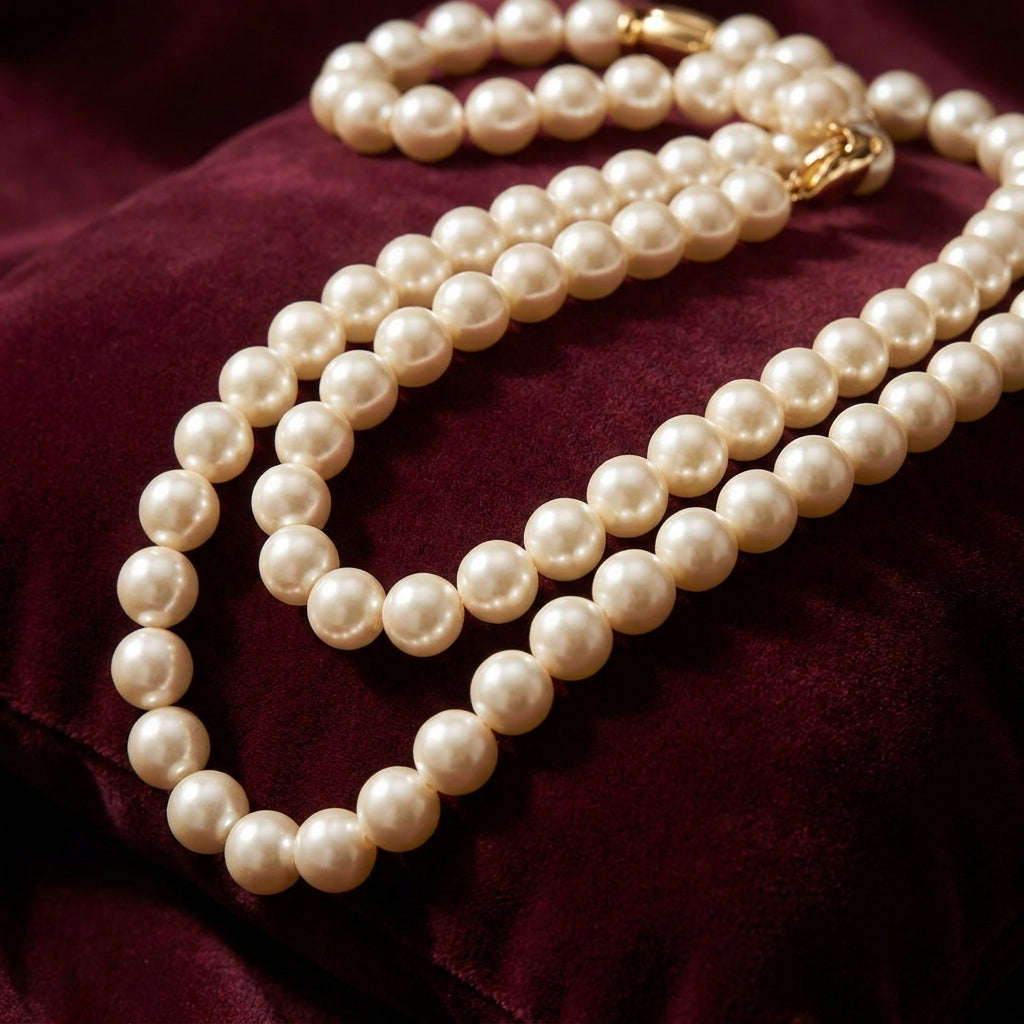
What simulated pearls actually are, how they are made, what they cost next to real cultured freshwater pearls, whether they hold any value and when they make sense.
Leave a comment
All comments are moderated before being published.
This site is protected by hCaptcha and the hCaptcha Privacy Policy and Terms of Service apply.