



Imitation Pearl Necklace: What Simulated Pearls Are Worth
Table of Contents
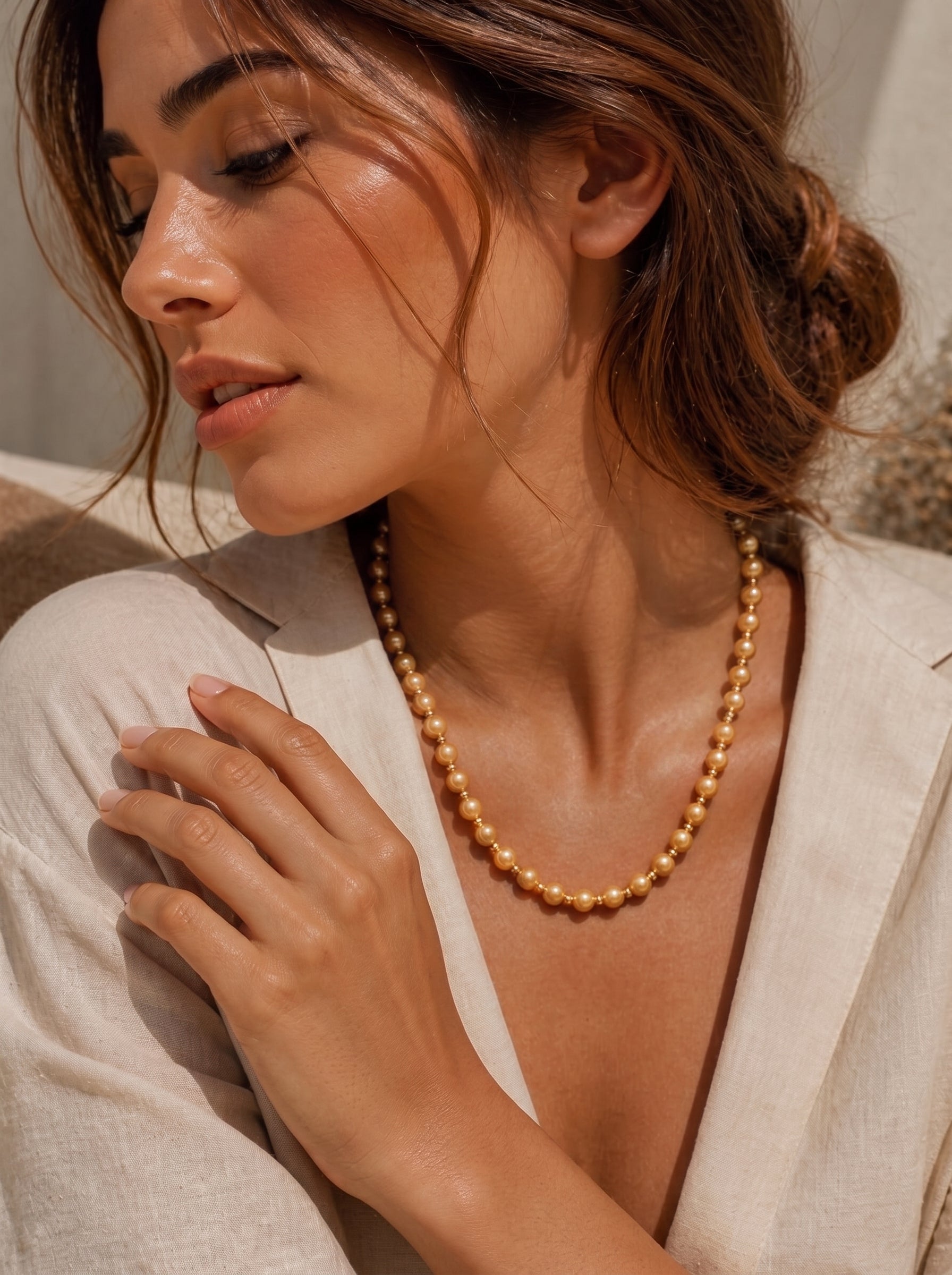
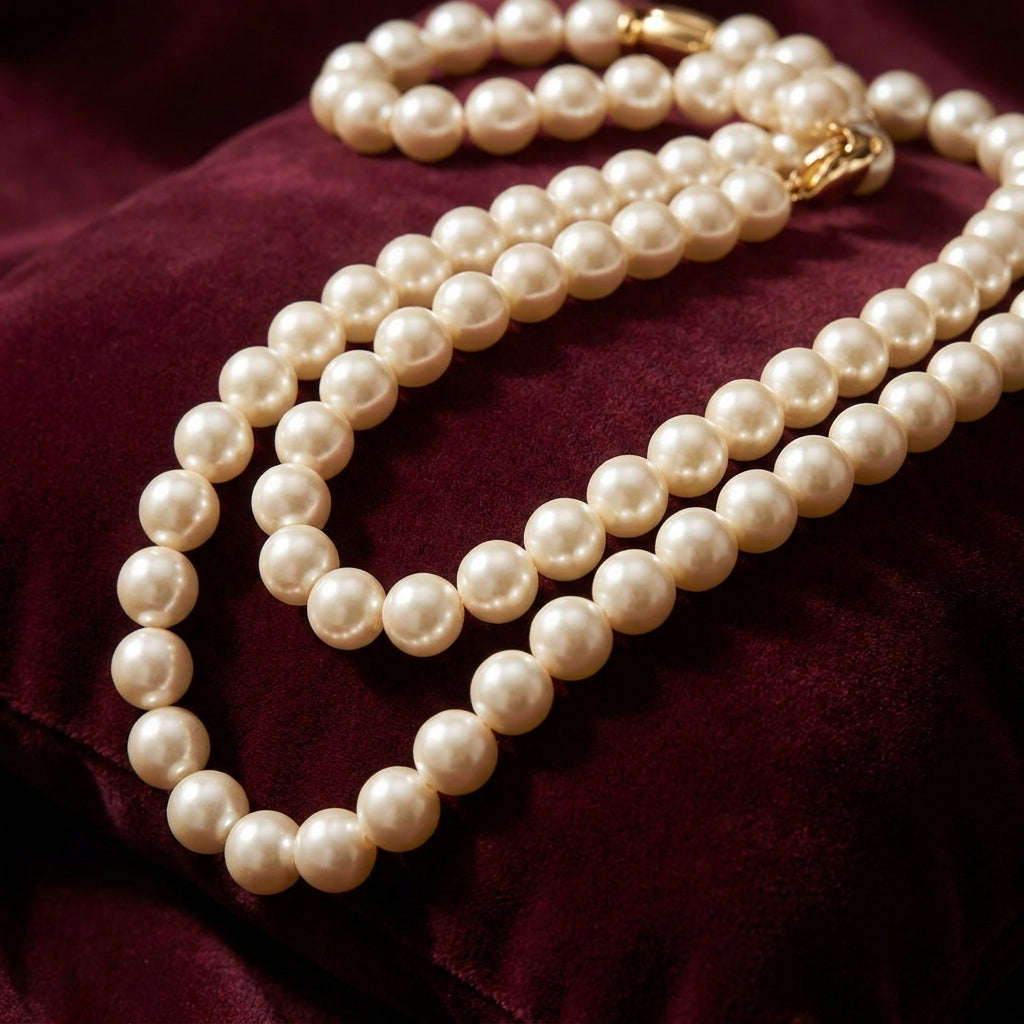
An imitation pearl necklace, also sold as a simulated or faux pearl necklace, is made of manufactured beads, usually glass, plastic or shell, coated to look like pearls. Premium versions can use glass cores under many pearlescent coats. At Grande Lilith on 21 October 2026, imitation and cultured freshwater pieces sat in the same $32 to $45 price band.
Key takeaways
- Simulated pearls are not pearls. The FTC defines an imitation pearl as a manufactured product designed to simulate a pearl or cultured pearl (16 CFR §23.19).
- The label must say so: "imitation," "simulated" or "artificial" must come immediately before "pearl," with equal prominence (16 CFR §23.20).
- A coating does the work of nacre. In one GIA study of a premium glass-core imitation, the coating was about 0.2 mm thick, against 0.5 to 0.8 mm of nacre on the cultured pearls examined.
- Resale value is low or nil as pearls; any value comes from the design, the maker or vintage collectability.
- At the same price, a cultured freshwater pearl gives you a real pearl; a simulated pearl gives you perfect uniformity.
Simulated pearls occupy an odd middle ground: some cost as much as real cultured pearls, yet none of them is a pearl. This guide explains honestly what they are, how they are made, what they cost, what they are worth later, and when they are a sensible buy. We sell both imitation and cultured pearl jewelry, so we compare the two with our own prices rather than other brands'. For the wider buying basics, see our complete pearl necklace buyer's guide.
What is a simulated pearl?
A simulated pearl is a manufactured bead made to look like a pearl. The core can be glass, plastic or shell, and a pearlescent coating supplies the luster and color. Simulated, imitation, faux and artificial pearls all describe the same category: products that resemble pearls but were never formed inside a mollusk.
The FTC Jewelry Guides draw the line clearly. Under 16 CFR §23.19, a pearl forms naturally inside a mollusk without human involvement; a cultured pearl forms when people place a nucleus in the mollusk, which then coats it with nacre; and an imitation pearl is "a manufactured product" made of any material to simulate a pearl or cultured pearl in appearance.
Simulated pearls vary enormously in quality. At one end are inexpensive plastic beads with a thin spray finish. At the other are premium glass pearls, built up with many coats and sold under well-known names at prices that can rival cultured pearls. Both are imitations; the difference lies in how convincing and how durable the coating is.
Are simulated pearls real pearls?
No. Simulated pearls are not real pearls, natural or cultured, however good they look or however much they cost. The FTC Jewelry Guides say the word "pearl" used for an imitation must be immediately preceded by "artificial," "imitation," "simulated" or an equivalent word, with equal conspicuousness, so that buyers are not misled.

The Guides go further on the words that surround a pearl:
- Faux and fashion pearls: terms such as "faux pearl" and "fashion pearl" also need the qualifier when they describe an imitation (§23.20(d)).
- Real and genuine: "real," "genuine" and "precious" are deceptive when used for imitation pearls (§23.21(i)).
- Cultured and natural: calling an imitation "cultured" is deceptive (§23.21(a)), and so is calling it "natural" (§23.21(e)).
- Regional names: designations such as "Japanese Pearls" or "Chinese Pearls" need a qualifier such as "imitation" or "cultured" in front (§23.21(k)).
A shell-based bead is a common source of confusion. A manufactured bead made from shell and coated to look like a pearl is still an imitation under the FTC definition, even though shell is a natural material. We explain the differences in detail in shell pearls vs real pearls.
If you are unsure what you already own, our guide on how to tell if pearls are real explains safe checks you can do at home.
How are simulated pearls made?
Simulated pearls are made by forming a core bead and coating it with a pearlescent finish. In premium glass pearls, the core is dipped repeatedly, dried and polished between coats, then sealed. Plastic cores are also coated, and methods vary by maker. Shell-based imitations start from a shell core or compressed shell powder before coating.
The most detailed public account of the process comes from a 1990 study by GIA researchers, published in GIA's journal Gems & Gemology, of a premium glass-core imitation pearl. The authors reported that:
- The core was a lead silicate glass bead. Larger round beads and pear shapes were formed by hand by melting glass rods onto a wire; smaller round beads were machine-made.
- The coating was a "pearl essence" based on guanine from fish scales, mixed with binding and coloring agents and applied in successive dips, with drying and polishing in between.
- A final dip hardened the surface to protect it from chipping and from discoloration caused by ultraviolet light.
- The coating was about 0.2 mm thick, compared with 0.5 to 0.8 mm of nacre on the cultured pearls the authors examined.
That study describes one high-end product, not every imitation on the market. Lower-priced simulated pearls may use plastic cores and simpler coatings, and many makers do not publish their methods.
The same study explains how a gemologist separates the two. Under 10x magnification, the drill hole of a cultured pearl shows a dark layer separating nacre from nucleus and a crisp edge; the imitation showed no such separation and a ragged coating edge. At higher magnification, cultured pearls showed a step-like surface, while the imitation's surface looked pitted. The authors also noted that the familiar tooth test, gritty for nacre and smooth for coating, can damage pearls and is not foolproof.
How much do simulated pearls cost?
Simulated pearls can range from a few dollars for plastic costume beads to prices comparable with cultured pearls for premium glass pearls sold under well-known names. There is no reliable public price index for imitation pearls, so compare each piece's materials and finish rather than assuming that a higher price means a better product.
We can show the comparison precisely with our own catalog. On 21 October 2026, Grande Lilith listed:
- 17 imitation pearl pieces, priced from $32 to $99, with a median of $38. Fifteen of the 17 cost between $32 and $45.
- 288 cultured freshwater pearl pieces, of which 221 cost between $32 and $45, again with a median of $38 in that band.
In other words, in our range a simulated pearl and a real cultured freshwater pearl cost the same. Here is what that looks like side by side, all on stainless steel:
| Piece | Pearl | Size and shape | Price |
|---|---|---|---|
| Aurora layered necklace | Imitation pearl | 6 mm, round | $36 |
| Verve necklace | Cultured freshwater pearl | 8 mm, button | $36 |
| Woven Orb hoop earrings | Imitation pearl | 18 mm, round | $36 |
| Luminous Flow hoop earrings | Cultured freshwater pearl | 8 mm, seed | $36 |
Grande Lilith prices and specifications on 21 October 2026.
The specification gap is the point. At $36, the imitation gives you a larger or perfectly round, perfectly matched look; the cultured freshwater piece gives you a real pearl, grown in a mollusk, with a listed origin and the small irregularities that come with it.
Do simulated pearls hold value?
Simulated pearls hold little or no value as pearls, because the material itself is inexpensive and they are not gems. Any resale value comes from something else: a recognized maker, an attractive or collectible vintage design, or precious metal in the clasp or setting. Buy a simulated pearl for how it looks and wears, not as an asset.

Three factors decide how long a simulated pearl keeps its looks:
- Coating quality. Thin coatings can wear through, chip or peel, especially around the drill hole where the bead meets the thread or wire.
- Exposure. Perfume, lotions, chlorine and abrasion all wear surfaces. The GIA authors found no color change in their premium sample after a week in perfume and a week of summer sun, but noted that this test was not conclusive.
- Construction. Knotting, clasps and metal quality affect how long the piece survives daily wear.
Cultured pearls are not investments either: secondhand jewelry generally sells below its original retail price. The difference is that a cultured pearl has gem value of its own, while a simulated pearl does not. Our guide to whether pearls hold their value covers the cultured side in detail.
The table compares the three main options.
| Factor | Simulated pearl (glass or plastic core) | Shell-based imitation pearl | Cultured freshwater pearl |
|---|---|---|---|
| Composition | Glass or plastic bead with a pearlescent coating | Shell core or compressed shell powder with a pearlescent coating | Nacre grown by a freshwater mussel |
| Typical price | From a few dollars to premium-brand prices; $32 to $99 at Grande Lilith | Varies widely; no reliable public benchmark | Mostly $32 to $45 at Grande Lilith (221 of 288 listings) |
| Lifespan | Depends on the coating, which can wear, chip or peel | Depends on the coating, as for other imitations | Nacre can last for decades with proper care |
| Resale value | Little or none as pearls; depends on maker and design | Little or none as pearls | Modest; secondhand jewelry generally sells below retail |
| Legal naming (FTC) | "Imitation," "simulated" or "artificial" pearl | Also an imitation, so the same qualifier applies | "Cultured" or "cultivated" pearl |
When are simulated pearls a reasonable choice?
Simulated pearls are a reasonable choice when you want a specific look, such as large, perfectly round and perfectly matched beads, at a modest price, or when the piece is a trend item, a costume, or something you would rather not risk losing. They are a poor choice when you want a lasting heirloom or a gem with value of its own.
Situations where a simulated pearl makes sense:
- A bold or oversized look. Very large, perfectly round beads are far cheaper in imitation than in cultured pearl.
- Perfect matching. Manufactured beads can be identical in size, shape and color in a way natural growth rarely is.
- Trend and statement pieces you expect to wear for a season or two.
- Costume, stage or event wear, where appearance at a distance matters more than material.
Situations where a cultured pearl is the better buy:
- A gift meant to last, or a first "real" pearl.
- Everyday wear for years, where a coating would eventually show wear.
- When the price is the same anyway, as it is across most of our range.
Whatever you choose, buy from a seller that labels it honestly. Our guide on where to buy real pearls online explains what a good listing should disclose, and designer pearl jewelry: what you are paying for covers the luxury end of the market.
Choosing an imitation pearl necklace or a cultured one
Choose an imitation pearl necklace for a specific look at a low price, and a cultured pearl necklace when you want a real gem that can last for decades. Check the label either way: an honest seller says "imitation," "simulated" or "cultured" plainly, right in front of the word "pearl."
Browse our imitation pearl jewelry, or compare it with our cultured freshwater pieces at the same price. For a broader side-by-side, read faux pearls vs real pearls.
Legal information in this article is a summary for shoppers, not legal advice.
Have you ever owned a pearl you later discovered was simulated? What gave it away?
Frequently Asked Questions
What is an imitation pearl necklace?
An imitation pearl necklace is made of manufactured beads, usually glass, plastic or shell, coated with a pearlescent finish to look like pearls. No mollusk grows them. Simulated, imitation, faux and artificial pearls all describe the same category of product.
Are simulated pearls real pearls?
No. Simulated pearls are imitations, not natural or cultured pearls. Under the FTC Jewelry Guides, the word pearl used for an imitation must be immediately preceded by imitation, simulated, artificial or an equivalent word, with equal prominence.
How are glass imitation pearls made?
Glass imitation pearls start as glass beads that are coated with a pearlescent finish, dried and polished between coats, then sealed. In a 1990 GIA study of one premium glass-core imitation, the coating was about 0.2 mm thick and based on guanine from fish scales.
Do simulated pearls hold their value?
Simulated pearls hold little or no value as pearls because they are not gems. Any resale value depends on the maker, the design, vintage collectability or precious metal in the setting. Buy them for their look rather than as an asset.
How long do imitation pearls last?
How long imitation pearls last depends on the quality of the coating and how they are worn. Coatings can wear through, chip or peel, especially around the drill hole. Keeping them away from perfume, lotions and abrasion helps them last longer.
How can you tell a simulated pearl from a real one?
Under 10x magnification, a real pearl's drill hole shows nacre layers with a crisp edge, while an imitation often shows a ragged coating edge. Real pearls usually feel slightly gritty against the teeth and imitations smooth, but this test is not foolproof and can damage pearls. A gemological laboratory gives the definitive answer.
Are imitation pearls cheaper than real pearls?
Not always. Inexpensive imitations cost a few dollars, but premium glass imitations can cost as much as cultured pearls. At Grande Lilith on 21 October 2026, most imitation and cultured freshwater pieces were priced in the same $32 to $45 range.
Read more
A seller-neutral framework for buying real pearls online: what a good listing must disclose, what return policy to expect, how to compare prices fairly and the warning signs of a bad seller.

Pearl studs or pearl drops for your first pair? A clear comparison of versatility, comfort, office suitability, photographs and durability, with prices from our own catalog.
Leave a comment
All comments are moderated before being published.
This site is protected by hCaptcha and the hCaptcha Privacy Policy and Terms of Service apply.