



Edison Pearls: The Freshwater Pearl That Competes With South Sea
Table des matières
- What is an Edison Pearl? (The Technological Breakthrough)
- Key Distinguishing Features of Edison Pearls
- Edison vs. South Sea Pearls: A Head-to-Head Comparison
- Freshwater Pearls Value: Price-per-Millimeter & Market Reality
- How to Buy & Care for Edison Pearl Jewelry
- Conclusion: The Modern Luxury Smart Choice
An Edison pearl is a giant, bead-nucleated freshwater pearl that redefines freshwater pearls value by offering South Sea dimensions (11mm to 18mm+) and intense metallic luster. Cultivated in hybrid freshwater mussels (Hyriopsis) using single-bead nucleation, high-grade 14mm Edison strands cost $2,000 to $5,000—delivering 70% cost savings compared to equivalent $15,000+ ocean South Sea strands.
For decades, the pearl industry maintained a clear, rigid hierarchy. Saltwater pearls, such as Japanese Akoyas, Tahitian black pearls, and Australian South Sea pearls, were celebrated as the ultimate luxury treasures reserved for fine jewelry houses. Freshwater pearls, by contrast, were often dismissed as budget-friendly alternatives: small, rice-shaped, semi-baroque gems produced by the dozen inside river mussels.
However, a quiet technological revolution has overturned this long-standing myth.
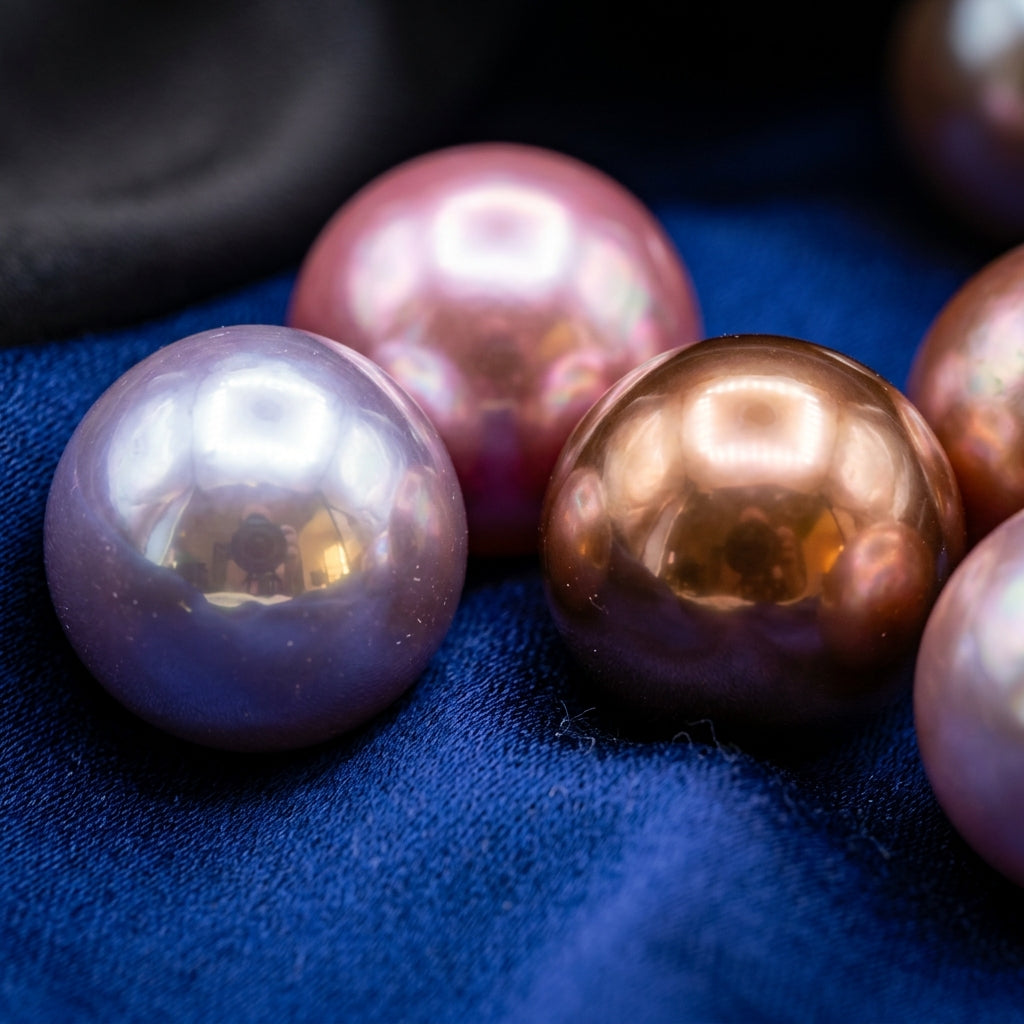
Enter the Edison pearl, a breakthrough class of giant, perfectly round freshwater pearls that feature mirror-like metallic luster, exotic natural colors, and diameters ranging from 11mm to over 18mm. For the first time in gemological history, a freshwater pearl can stand side-by-side with a rare Australian South Sea gem and match its commanding presence.
Whether you are seeking a bold statement necklace or re-evaluating smart investment choices in fine jewelry, this guide explores how Edison pearls were developed, why their metallic brilliance is capturing international acclaim, and how they offer unmatched value in today's gemstone market.
For a comprehensive overview of every pearl variety in existence, consult our master guide: Types of Pearls: The Complete Guide to Every Pearl Variety.
What is an Edison Pearl? (The Technological Breakthrough)
The name "Edison Pearl" pays homage to the legendary inventor Thomas Edison, who famously lamented: "There are two things which cannot be made in my laboratory, diamonds and pearls."
Developed after years of intensive genetic research by Grace Pearl Corporation in Zhuji, Zhejiang Province, China, Edison pearls represent a total departure from traditional freshwater farming techniques.
Rather than inserting 20 to 30 tiny pieces of donor mantle tissue into a single mussel, which forces the host to produce dozens of small, irregular pearls, Edison pearl farmers insert a single round shell bead nucleus along with a tiny piece of donor tissue into the mussel's body.
Furthermore, farmers utilize a special hybrid mussel species created by crossbreeding Hyriopsis cumingii (the Chinese triangle sail mussel) with Hyriopsis schlegeli (the Japanese Biwa mussel). This hybrid mussel possesses extraordinary shell dimensions and superior nacre secretion capabilities.
Because the mussel devotes 100% of its energy and nutrients to cultivating a single pearl over 3 to 5 years, the resulting gem accumulates a thick, dense nacre coating (1.5mm to 3.5mm) over the bead core, achieving giant dimensions previously exclusive to ocean oysters.
Key Distinguishing Features of Edison Pearls
Edison pearls are instantly recognizable by three standout gemological qualities:
1. Extraordinary Size Range (11mm to 18mm+)
While classic freshwater pearls average 6mm to 9mm in diameter, Edison pearls routinely harvest at 11mm to 14mm, with rare top-grade specimens exceeding 17mm or 18mm. This massive scale places them in direct visual competition with South Sea pearls.
2. Mirror-Like Metallic Luster
Traditional freshwater pearls are loved for their soft, satiny glow. Edison pearls, however, exhibit an intense metallic luster characterized by crisp specular reflections. Light bounces off the tightly stacked aragonite crystal platelets with dramatic mirror sharpness, rivaling the finest Japanese Akoya or Tahitian gems.
3. The Natural Metallic Color Spectrum
Perhaps the most captivating aspect of Edison pearls is their natural color palette. Unlike saltwater oysters that produce primarily white, gold, or grey pearls, hybrid freshwater mussels yield rich, untreated metallic shades:
Metallic Pink & Peach: Warm, glowing rose and copper tones.
Deep Plum & Magenta: Rich burgundy, violet, and eggplant hues.
Metallic Bronze & Champagne: Golden metallic tones resembling 24k gold.
Metallic Lavender & Purple: Electric purple tones unique to freshwater aquaculture.

Edison vs. South Sea Pearls: A Head-to-Head Comparison
To understand how Edison pearls compare to the world's most expensive ocean gems, examine the direct comparison below:
The table below outlines the key gemological differences between Edison pearls and saltwater luxury categories:
For a detailed comparison of non-beaded all-nacre gems, read our guide on What Are Keshi Pearls?.

Freshwater Pearls Value: Price-per-Millimeter & Market Reality
Evaluating true freshwater pearls value requires understanding how bead-nucleation technology transformed the price-per-millimeter curve.
In traditional pearl pricing, value increases exponentially with diameter because large pearls are rare. A 15mm White South Sea pearl commands an astronomical price ($2,000 to $5,000 per loose gem) due to high oyster mortality rates in ocean waters.
Edison pearls disrupt this economic curve. Because freshwater mussels are hardier and lake environments allow higher cultivation control, farmers can produce large 13mm to 16mm spherical pearls with lower risk of mollusk loss.
As a result, a buyer seeking a large, high-impact 14mm pearl necklace can acquire a certified metallic Edison strand for $2,000 to $5,000, delivering the same dramatic visual presence as a $20,000 South Sea strand while saving 70% to 80%.
To explore half-dome shell pearls built for statement jewelry, see What Is a Mabe Pearl?.

How to Buy & Care for Edison Pearl Jewelry
When purchasing Edison pearls online or at luxury boutiques, follow these gemological buying rules:
Verify Natural Color vs. Dye Treatments: High-grade Edison pearls naturally produce metallic pink, bronze, and plum colors. However, some lower-quality pearls are color-treated or irradiated to mimic deep metallic hues. Always insist on vendor documentation confirming natural color origin.
Inspect Surface Roundness & Blemishes: Because Edison pearls grow around a round bead nucleus, top-grade pearls achieve spherical roundness. Check for minor pinpoints or organic wrinkles under natural daylight.
Store Separately in Breathable Pouches: Like all cultured pearls, Edison nacre is composed of organic aragonite crystals bound by conchiolin. Keep your pearls away from harsh acidic chemicals, hairsprays, and perfumes, and store them in soft cloth pouches.
For step-by-step guidance on evaluating pearl construction, consult our guide on How to Buy a Pearl Necklace: The Buyer's Guide.
Conclusion: The Modern Luxury Smart Choice
Edison pearls represent the perfect union of scientific innovation and natural beauty. By combining the massive scale of ocean South Sea gems with the vibrant metallic color palette of freshwater aquaculture, Edison pearls allow modern jewelry lovers to make an unforgettable luxury statement.
Explore our metallic freshwater pearls in the freshwater pearl necklace collection.
Frequently Asked Questions (FAQ)
What is an Edison pearl?
An Edison pearl is a giant, bead-nucleated freshwater pearl cultivated in hybrid mussels (Hyriopsis cumingii x schlegeli) in China. They are famous for their large sizes (11mm to 18mm+), spherical roundness, and mirror-like metallic luster.
Are Edison pearls real freshwater pearls?
Yes. Edison pearls are 100% real cultured freshwater pearls grown inside living lake mussels over 3 to 5 years.
Why are Edison pearls more expensive than regular freshwater pearls?
Edison pearls are more expensive because each mussel produces only one single pearl (compared to 24–32 pearls in traditional freshwater farming). Their giant sizes, bead nucleation, and intense metallic colors require advanced technicians and longer cultivation times.
Are Edison pearls dyed?
Top-quality Edison pearls can show naturally occurring colors, including metallic pink, peach, bronze, gold, plum, and lavender. Always buy from reputable jewelers who guarantee natural color origin.
How do Edison pearls compare to South Sea pearls?
Edison pearls match South Sea pearls in size (11mm–18mm) and roundness. However, Edison pearls offer a sharper, mirror-like metallic luster and unique pink/plum colors, whereas South Sea pearls feature a soft, satiny glow in white or gold. Edison pearls cost roughly 70% less than equivalent South Sea pearls.
Read more

Are blemishes on pearls normal or a sign of damage? Learn how to evaluate pearl surface quality like a gemologist. Discover the 6 major types of surface features, distinguish harmless growth marks ...
Demystify shell pearls versus real cultured pearls. Learn how carved clam shell cores and ground mother-of-pearl coatings are made, discover 40-sample tooth test & density lab data, and underst...
Leave a comment
All comments are moderated before being published.
This site is protected by hCaptcha and the hCaptcha Privacy Policy and Terms of Service apply.