



How to Verify and Certify Your Authentic Pearl Necklace
Table des matières
- The Top 4 Independent Gemological Laboratories for Authentic Pearl Necklaces
- What a Pearl Lab Report Proves (And Ignores) for Your Genuine Pearl Necklace
- Why Nacre Thickness is Critical for Your Authentic Pearl Necklace
- Understanding Pearl Grades and Their Impact on Value
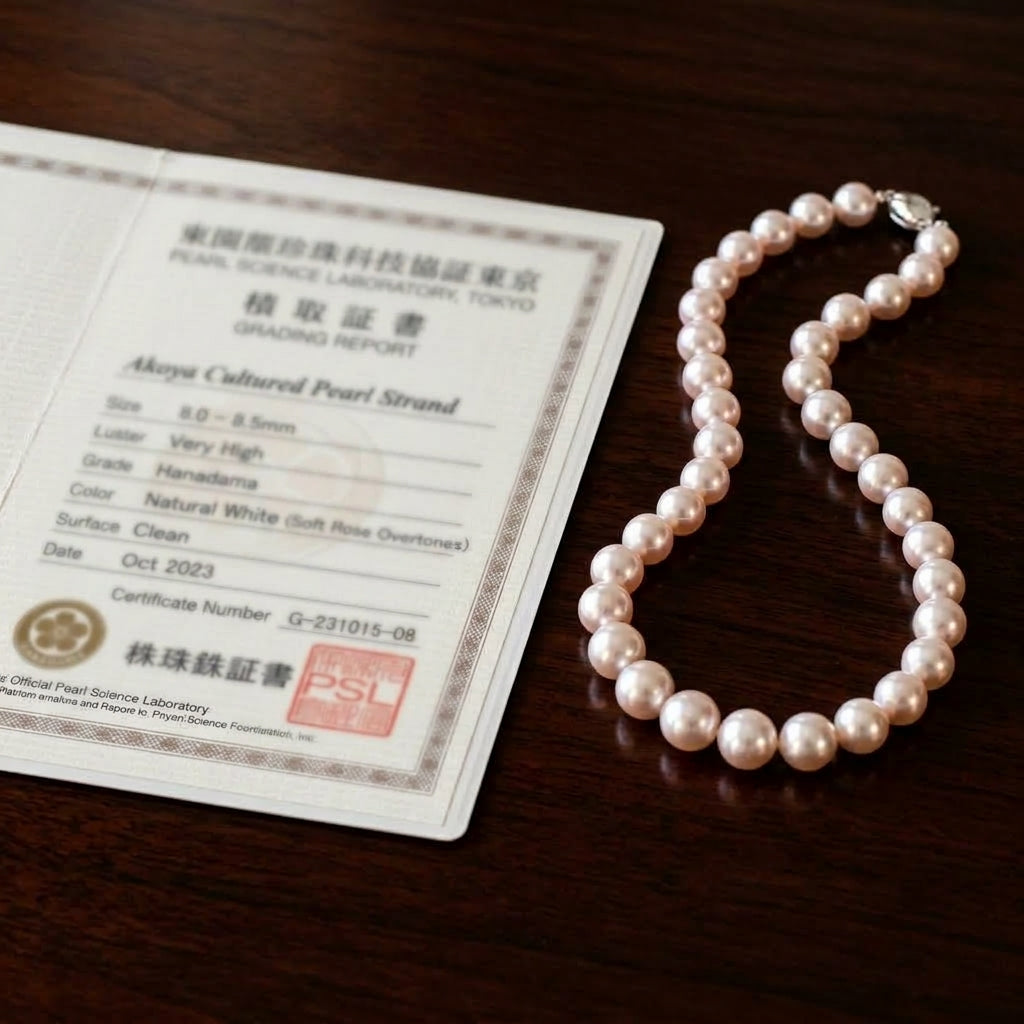
- Decoding Hanadama & Tennyo Certificates for Japanese Akoya Pearls
- In-House Certificates vs. Independent Lab Reports
- Diagnostic Comparison: Lab Testing Technologies vs. Information Proved
- When Is Paying for a Pearl Certificate Worth It?
- Final Guidance
A gemological certificate for an authentic pearl necklace scientifically verifies mollusk origin, natural versus cultured growth, environment, and artificial treatments. Independent lab reports verify physical authenticity rather than setting financial appraisals or commercial retail values. Published fees for GIA ($100–$300, 10–15 day turnaround) and PSL Japan ($120–$250, 7–14 day turnaround) utilize X-ray microradiography to confirm nacre depth. Ensuring you possess an authentic pearl necklace is paramount for both investment and peace of mind.
In the world of fine jewelry, few terms create as much confusion as "certified pearls." Buyers frequently assume that when a retailer includes an authenticity card, certificate, or grading report, the document guarantees flawless aesthetic perfection and high resale value.
In reality, a gemological laboratory report is a scientific analysis document, not a sales pitch or a financial appraisal. Independent gemological laboratories do not assign monetary valuations, nor do they guarantee that a gem fits a buyer's personal aesthetic taste. Instead, specialized lab reports provide objective, verifiable data regarding mollusk origin, natural versus cultured growth, cultivation environment, artificial treatments, and structural nacre thickness. This scientific verification is crucial for anyone seeking a genuine pearl necklace or real pearl jewelry.
Understanding what a laboratory report actually proves, and what it ignores, empowers you to distinguish genuine third-party scientific documentation from meaningless in-house marketing cards.
The Top 4 Independent Gemological Laboratories for Authentic Pearl Necklaces
When evaluating an authentic pearl necklace, the authority of the certifying body determines the report's credibility. Four independent gemological institutions set the global standard for pearl analysis. These world-renowned laboratories provide unbiased, scientific verification, ensuring buyers can confidently identify genuine pearl necklaces and real pearl jewelry.
Master Laboratory Comparison Matrix
Let's delve deeper into what each of these premier institutions offers for the certification of your authentic pearl necklace:
Gemological Institute of America (GIA): Renowned globally, GIA provides comprehensive identification and classification services for all types of pearls. Their reports are highly respected and essential for verifying the fundamental characteristics of any genuine pearl necklace.
Pearl Science Laboratory (PSL): Based in Tokyo, PSL is the leading authority for Japanese Akoya pearls, particularly known for its stringent Hanadama and Tennyo grading. A PSL certificate is the gold standard for high-quality Akoya cultured pearls, ensuring superior luster and nacre thickness for your authentic pearl necklace.
Swiss Gemmological Institute (SSEF): Specializing in high-value natural sea pearls and antique estate jewelry, SSEF employs advanced technologies like Micro-CT scanning and radiocarbon dating. Their reports are critical for authenticating rare and historically significant real pearl jewelry.
Central Gem Laboratory (CGL): Another esteemed Japanese laboratory, CGL focuses on quality grading for saltwater Akoya and Tahitian pearls. Their expertise ensures precise evaluation of these exquisite pearl grades, contributing to the credibility of your genuine pearl necklace.
What a Pearl Lab Report Proves (And Ignores) for Your Genuine Pearl Necklace
A certified report from a recognized gemological laboratory provides definitive answers to critical authenticity questions for your authentic pearl necklace. It offers clear, objective data that empowers you to make informed decisions about your real pearl jewelry.

1. What a Lab Report Scientifically Proves
Natural vs. Cultured Origin: Differentiating a wild pearl formed spontaneously in nature from a cultured pearl grown on a farm is the primary function of a lab report. Using X-ray microradiography, gemologists inspect the inner core. Natural pearls show continuous concentric growth rings of organic nacre, while cultured pearls reveal a spherical shell bead nucleus or a tissue-nucleated cavity. This distinction is fundamental when identifying a genuine pearl necklace.
Environment (Freshwater vs. Saltwater): Laboratories utilize Energy-Dispersive X-Ray Fluorescence (EDXRF) to measure trace element concentrations. Freshwater pearls harvested from mussels (Hyriopsis cumingii) contain elevated manganese levels (>100 ppm), whereas saltwater pearls (Pinctada species) contain negligible manganese levels. Knowing the origin helps in understanding the characteristics of different pearl grades.
Treatments & Artificial Modifications: Lab reports explicitly state whether a pearl has undergone post-harvest enhancements beyond standard washing. Tests identify gamma-ray irradiation (used to darken freshwater cores), silver nitrate chemical dyeing (used to create black overtones), and aggressive acid bleaching. Unveiling treatments ensures the transparency and true value of your authentic pearl necklace.
Nacre Thickness Measurement: For bead-nucleated akoya cultured pearls, labs measure exact nacre depth in millimeters using X-ray imaging. Verifying a nacre thickness of 0.40mm or greater ensures the gem will not peel or wear through over time. This is a vital factor in the longevity and quality assessment of any genuine pearl necklace.
2. What a Lab Report IGNORES
Dollar Appraisal Values: Independent laboratories never list dollar values. Any certificate displaying a "$2,500 estimated retail value" is an in-house marketing appraisal printed by a seller, not a scientific lab report. Focus on the scientific facts for your authentic pearl necklace, not speculative valuations.
Subjective Personal Beauty: A laboratory report documents physical facts (e.g., "7.5mm white cultured Akoya pearl"). It does not judge whether the pearl's overtone matches your skin tone or personal wardrobe. The aesthetic appeal of a genuine pearl necklace remains a personal choice.
Why Nacre Thickness is Critical for Your Authentic Pearl Necklace
Nacre thickness is arguably one of the most vital characteristics when assessing the quality and durability of a cultured pearl, especially for an authentic pearl necklace. Nacre is the iridescent, crystalline substance secreted by the mollusk that forms the pearl itself. A thicker nacre layer directly correlates with greater luster, richer overtone, and superior durability. Pearls with thin nacre are prone to developing "bald spots" where the bead nucleus shows through, or even peeling over time, significantly reducing their beauty and lifespan. For Akoya cultured pearls, in particular, a minimum nacre thickness of 0.40mm per side, as required for Hanadama certification, is a benchmark for ensuring a long-lasting and beautiful genuine pearl necklace. Always prioritize pearls with verified nacre thickness to protect your investment in real pearl jewelry.
Understanding Pearl Grades and Their Impact on Value
Beyond basic authenticity, understanding pearl grades is essential for appreciating the true value of an authentic pearl necklace. While there isn't one universal grading system like the 4Cs for diamonds, reputable laboratories and industry standards focus on several key factors:
Luster: The intensity and sharpness of light reflection from the pearl's surface. High luster is crucial for a radiant genuine pearl necklace.
Surface Quality: The presence or absence of blemishes, spots, or irregularities. Cleaner surfaces command higher pearl grades.
Shape: How round or symmetrical the pearl is. Perfectly round pearls are the rarest and most valuable, especially for akoya cultured pearls.
Color & Overtone: The body color and any secondary hues (overtones) visible on the surface. These are often a matter of personal preference but can affect market value.
Size: Measured in millimeters, larger pearls are generally rarer and thus more valuable, assuming other quality factors are equal.
These combined factors contribute to a pearl's overall grade and, consequently, its market value. A certified authentic pearl necklace with high pearl grades represents a significant investment in real pearl jewelry.
Decoding Hanadama & Tennyo Certificates for Japanese Akoya Pearls
Among saltwater cultured pearls, Japanese Akoya pearls (Pinctada fucata) command immense popularity. However, because commercial Akoya pearls are bead-nucleated, nacre depth varies significantly across farms. To protect consumers, the Pearl Science Laboratory (PSL) in Tokyo established the prestigious "Hanadama" certification standard. This certification is vital for ensuring the quality and longevity of high-end akoya cultured pearls, making them a truly authentic pearl necklace.
The 4 Strict Criteria for Hanadama Certification
"Hanadama" translates to "Spherical Flower Pearl." To earn a PSL Hanadama certificate, a genuine pearl necklace must pass four rigorous physical examinations:
Nacre Depth (≥ 0.40 mm): X-ray microradiography must confirm that the nacre layer surrounding the central bead nucleus measures at least 0.40mm thick on every side of the pearl. Strands with thin nacre (<0.25mm) are immediately disqualified. This ensures the durability and beauty of your akoya cultured pearls.
Teri (Luster Intensity): PSL uses optical spectrophotometry to measure reflection sharpness ("Teri"). Only pearls exhibiting top-tier mirror-like reflection achieve Hanadama status. Exceptional luster is a hallmark of high-grade Japanese Akoya pearls.
Surface Cleanliness: Under 10x magnification, the total surface blemish coverage across the entire matching strand must be under 5%. A clean surface enhances the overall appeal of an authentic pearl necklace.
Shape Symmetry: Roundness variation across every pearl in the strand must remain under 1.0%. Perfectly round pearls are highly valued in genuine pearl necklaces.
The Tennyo Upgrade: Tennyo ("Celestial Maiden") represents an elite sub-category of Hanadama pearls that demonstrate exceptionally strong multi-color overtone orient (vibrant pink and green reflections simultaneously) under specialized optical filters. This signifies the pinnacle of Japanese Akoya pearls and is often sought after for the most exquisite authentic pearl necklace designs.
Our customers consistently praise the exceptional quality and verified authenticity of our pearl collections. Discover why they trust us for their genuine pearl jewelry needs. Read customer reviews here.
In-House Certificates vs. Independent Lab Reports
Understanding the distinction between vendor-issued cards and independent lab reports prevents costly buying mistakes, especially when investing in an authentic pearl necklace.
1. In-House "Certificates of Authenticity"
Issuer: The retailer or seller.
Content: General promises such as "Guaranteed 100% Real Pearls" or "Genuine 14K Gold."
Scientific Weight: Zero. An in-house card is simply a receipt statement. It does not involve X-ray testing, EDXRF trace analysis, or independent verification. Relying solely on these for an authentic pearl necklace can be risky.
2. Independent Third-Party Lab Reports
Issuer: An accredited, non-commercial gemological laboratory (GIA, PSL, SSEF, CGL).
Content: Unique report identification number, high-resolution photograph, exact millimeter measurements, scientific identification of origin, and treatment details.
Scientific Weight: Definitive legal and gemological proof accepted by insurers and auction houses worldwide. This is the gold standard for verifying your genuine pearl necklace.
For broader context on avoiding common seller marketing traps, explore our guide on 8 pearl buying mistakes that cost people money.

Diagnostic Comparison: Lab Testing Technologies vs. Information Proved
Use this reference matrix to understand which scientific test produces each critical data point for authenticating your real pearl jewelry.
To understand how home testing compares against lab analysis, consult our guide on how to tell if pearls are real with 8 home tests.
When Is Paying for a Pearl Certificate Worth It?
Laboratory reports require time and money ($100 to $300+ in fees). Determining whether certification is necessary depends on the purchase price and pearl species, especially when aiming for an authentic pearl necklace with verified quality.
Under $300 (Freshwater & Silver Jewelry): Not worth paying for an independent lab report. A $150 GIA report on a $100 freshwater strand makes no financial sense. Rely on reputable sellers offering solid 30-day inspection guarantees. For these entry-level items, focus on vendor reputation rather than costly certification.
$300 – $1,000 (Japanese Akoya Strands): Highly recommended to request or purchase a Pearl Science Laboratory (PSL) Hanadama report. Verifying a 0.40mm nacre depth ensures your real pearl jewelry won't peel after a few years of wear. This is especially crucial for akoya cultured pearls, where nacre thickness directly impacts longevity and value as a genuine pearl necklace.
Over $1,000 (Tahitian, South Sea, & Natural Sea Pearls): Mandatory. High-value South Sea strands and rare natural pearls should always be accompanied by an official GIA, PSL, or SSEF report to confirm natural color, untreated nacre, and saltwater origin. For these significant investments, a certified authentic pearl necklace is non-negotiable, providing essential documentation for insurance and resale.
Final Guidance
A pearl lab report is the ultimate proof of gemological authenticity when backed by an accredited, independent laboratory. When investing in an authentic pearl necklace, certification provides unparalleled assurance and peace of mind.
At Grande Lilith, every Akoya pearl piece is listed with its pearl size, grade, treatment and metal. We are committed to providing only the highest quality akoya cultured pearls and real pearl jewelry, each verified for its exceptional pearl grades and authenticity.
Frequently Asked Questions
What is a pearl certificate?
A gemological certificate for an authentic pearl necklace scientifically verifies mollusk origin, natural versus cultured growth, environment, and artificial treatments. Independent lab reports verify physical authenticity rather than setting financial appraisals or commercial retail values. Published fees for GIA ($100–$300, 10–15 day turnaround) and PSL Japan ($120–$250, 7–14 day turnaround) utilize X-ray microradiography to confirm nacre depth.
What does a lab actually test?
Gemological laboratories test internal growth structure using X-ray microradiography, trace element composition using EDXRF, and chemical treatments using UV-Vis spectrophotometry. These tests prove whether a pearl is natural or cultured, freshwater or saltwater, and dyed or untreated.
What is a Hanadama certificate?
A Hanadama certificate is a specialized quality report issued by the Pearl Science Laboratory (PSL) in Tokyo for top-tier japanese akoya pearls. It guarantees a minimum nacre thickness of 0.40mm per side, superior mirror luster ("Teri"), under 5% surface blemishes, and near-perfect roundness.
Does a certificate guarantee quality?
A standard GIA identification report verifies species authenticity and treatments, but does not grade aesthetic quality. A PSL Hanadama report, however, specifically certifies top-tier nacre thickness and luster quality.
Which laboratories issue pearl reports?
The most reputable independent gemological laboratories for pearls are the Gemological Institute of America (GIA), Pearl Science Laboratory (PSL Japan), Swiss Gemmological Institute (SSEF), and Central Gem Laboratory (CGL Japan).
At what price is certification worth it?
Independent lab certification is generally worth paying for on purchases over $300 for Akoya strands (to verify Hanadama nacre thickness) and is mandatory for purchases over $1,000 involving Tahitian, South Sea, or natural sea pearls.
<u class='ai-highlight'>How do pearl grades affect value?</u>
<u class='ai-highlight'>Pearl grades, determined by factors like luster, surface quality, shape, color, and size, significantly impact the value of an authentic pearl necklace. Higher grades indicate rarer and more desirable characteristics, leading to a higher market value for genuine pearl necklaces and real pearl jewelry.</u>
Read more
How much should you spend on a real pearl necklace? Explore a realistic budget guide by life stage, covering $50 entry strands, $300 career milestones, and $1,000+ luxury heirlooms.

How to buy a pearl necklace: resolve the 6 core purchasing decisions, species type, size, length, overtone, clasp, and budget, with expert market data.
Leave a comment
All comments are moderated before being published.
This site is protected by hCaptcha and the hCaptcha Privacy Policy and Terms of Service apply.