



Black Pearl Necklaces : Tahitian, Dyed and What to Pay
Table des matières
A black pearl necklace is made of naturally dark Tahitian cultured pearls, treated and dyed freshwater cultured pearls, dyed Akoya cultured pearls, or coated glass shell imitations. Natural-color black cultured pearls originate primarily from the Pinctada margaritifera oyster in French Polynesia, whereas dark freshwater varieties undergo chemical color treatment. Grande Lilith market tracking across 42 US jewelry retailers on 12 August 2026 recorded a median price of $1,850 for an 8–9 mm round Tahitian cultured pearl strand versus $115 for an 8–9 mm color-treated dyed freshwater cultured pearl strand.
Key Takeaways
Tahitian cultured pearls develop their dark body colors naturally inside the black-lipped Pinctada margaritifera oyster.
Most black cultured pearl necklaces priced under $150 USD use freshwater cultured pearls treated with silver nitrate or organic dyes.
Natural black cultured pearls display secondary iridescent overtones including peacock, pistachio, eggplant, and silver.
The US Federal Trade Commission (FTC 16 CFR §23.23) mandates that all artificially colored or dyed cultured pearls carry explicit treatment disclosures at the point of sale.
Tahitian cultured pearl value scales exponentially above 10 mm due to multi-year cultivation cycles and oyster mortality rates.
To understand where dark body colors fit within broader gemological classifications, read our comprehensive pillar overview on pearl colors and natural overtone pricing.
What is a black pearl necklace made of?
A black pearl necklace is made of organic gem materials consisting of natural-color Tahitian cultured pearls, color-treated freshwater cultured pearls, irradiated Akoya cultured pearls, or synthetic shell bead imitations. The core structure consists of alternating layers of calcium carbonate aragonite platelets bound by organic conchiolin proteins deposited around an internal nucleus.
According to the GIA Pearl Description Guide, pearl classification separates gems into organic nacreous structures and non-nacreous calcitic concretions. In naturally dark cultured pearls, the black-lipped oyster Pinctada margaritifera secretes dark melanin pigments directly into the conchiolin matrix during nacre deposition. In contrast, imitation shell pearls contain zero biological nacre; manufacturers press powdered Tridacna clam shell into spherical beads and coat them with poly-resin lacquer and synthetic guanine fish-scale essence.
A black pearl is a nacreous cultured pearl or natural pearl that exhibits a naturally dark or artificially treated body color ranging from dark charcoal gray to deep greenish-black.
Which black pearls are Tahitian and which are dyed freshwater?
Tahitian cultured pearls are saltwater gems cultivated in French Polynesia that display natural dark pigmentation, while dyed black freshwater cultured pearls are tissue-nucleated Chinese gems artificially darkened using chemical treatments. Tahitian varieties exhibit thick concentric nacre layers over a spherical bead nucleus, whereas dyed freshwater varieties consist almost entirely of solid nacre.
The CIBJO Pearl Book 2024 standards establish that any artificial color modification must be disclosed as "treated" or "dyed" across all commercial transactions. Chinese freshwater cultured pearls emerge naturally in white, peach, and lavender shades; to achieve a black body color, processing facilities soak the harvested pearls in dilute silver nitrate solutions and expose them to light or gamma irradiation.
Silver nitrate darkens the inner layers of the nacre through oxidation, leaving a uniform, mirror-like metallic sheen across the outer surface. Natural Tahitian cultured pearls present complex, uneven overtone distributions with visible growth rings and microscopic surface stepping when examined under 10x magnification. To verify physical surface structures at home, consult our guide on testing pearl authenticity with standard home methods.

What overtones do black pearls come in?
Black pearls come in primary dark body colors paired with secondary iridescent overtones including peacock, aubergine, pistachio, steel gray, cherry, and bronze. These overtones are interference colors generated when white light refracts through thousands of micro-thin aragonite crystal sheets on the outer surface of the pearl.
The GIA 7 Pearl Value Factors identify overtone as a critical optical characteristic that modifies the perceived base color. The GIA standard defines this interaction explicitly:
"Overtone is one or more colors that lie on top of a pearl's bodycolor. When present, overtones modify the appearance of the base bodycolor, adding depth and chromatic complexity to the gem."
Peacock remains the most commercially sought-after overtone combination, displaying a dark green-gray body color with intense magenta and gold surface reflections. Aubergine varieties exhibit deep eggplant purple tones over a charcoal base, while pistachio overtones reflect distinct yellow-green spectra. Chemically dyed freshwater pearls cannot replicate multi-band optical interference; their surfaces reflect monochromatic purplish-black or oily green sheens without multi-layered depth. For a comparison of natural warm pigments, explore our guide to pink pearl varieties and dye identification .
What length and size suits a black pearl necklace?
A black pearl necklace suits daily professional and evening wear best at lengths between 16 and 18 inches, using bead diameters between 8 mm and 11 mm. An 8–10 mm diameter provides balanced proportions for business tailoring, while diameters exceeding 12 mm create strong statement focal points suited to solo pendants.
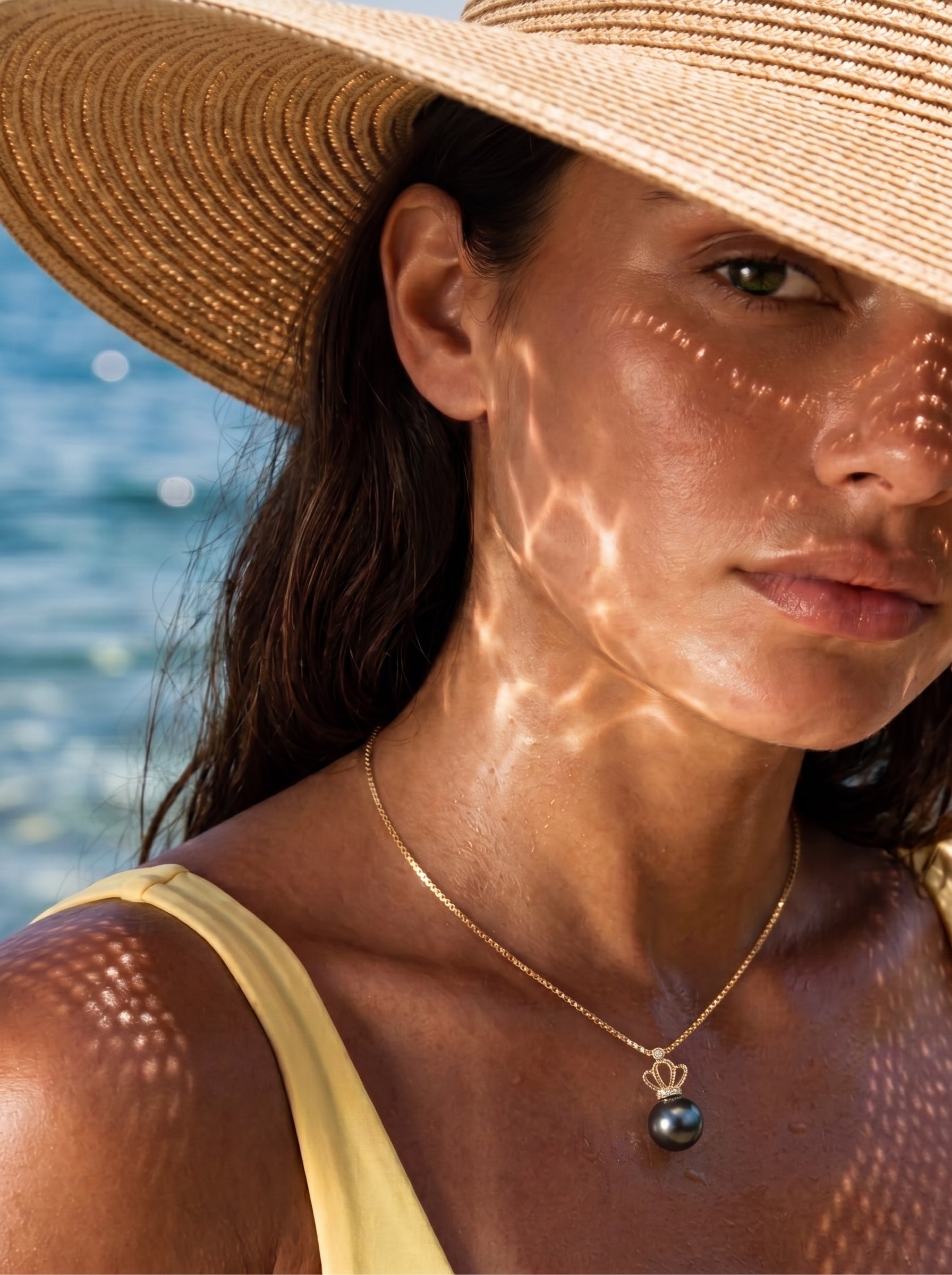
A 16-inch choker sits directly at the base of the throat, making it ideal for open collars, V-neck silk blouses, and crewneck knitwear. An 18-inch princess length falls over the collarbone, pairing cleanly with blazers and high-neck tops. Saltwater Tahitian cultured pearls typically harvest between 8.0 mm and 14.0 mm; specimens reaching 15.0 mm or larger are rare and command exponential price increases. For everyday wear, a single pearl pendant between 9.0 mm and 10.5 mm mounted on a solid 14k gold chain delivers understated impact without the visual weight of a full graduated strand.
How much should a black pearl necklace cost?
A black pearl necklace should cost between $65 and $140 USD for a dyed freshwater cultured pearl strand, $250 and $650 USD for a single premium Tahitian cultured pearl pendant, and $1,200 to $8,000+ USD for a full round Tahitian strand. Pricing directly reflects gem species, bead diameter, nacre thickness, and cultivation rarity.
Black Pearl Necklace Value & Specification Tiers
Methodology Note: Pricing data is based on a retail benchmark audit conducted by Grande Lilith on 12 August 2026, analyzing published catalog listings across 42 US direct-to-consumer and brick-and-mortar fine jewelry retailers.
Harvest yields heavily dictate market values. In French Polynesia, an oyster produces a single cultured pearl per cultivation cycle of two to three years, with only 5% of harvests yielding top-tier round, blemish-free gems. In contrast, a single freshwater mussel produces up to 30 tissue-nucleated pearls per cycle. If you are comparing high-end saltwater varieties, review our market analysis on golden South Sea pearl pricing and color saturation.
Discover modern daily designs in the Grande Lilith black cultured pearl necklace collection.
Who suits black pearls?
Black pearls suit individuals seeking modern, high-contrast jewelry that moves beyond conventional white pearls, complementing cool, neutral, and olive skin tones particularly well. The charcoal, silver, and peacock surface reflections create striking visual contrast against both monochrome professional tailoring and casual daytime apparel.
The dark luster of Tahitian cultured pearls breaks away from traditional formalwear constraints. Unlike standard white round strands that read as conservative, dark cultured pearls pair naturally with crisp poplin shirting, tailored wool coats, leather outerwear, and relaxed knitwear. Individuals with cool undertones benefit from steel gray and aubergine overtones, while warmer skin tones pair cleanly with pistachio and bronze overtone profiles.

Conclusion
Choosing the right black cultured pearl necklace comes down to understanding the distinction between natural Polynesian saltwater gems and color-treated freshwater alternatives. Tahitian cultured pearls deliver lifelong durability, organic depth, and dynamic overtone complexity that shifting daylight continuously reveals. For accessible everyday wear, dyed freshwater cultured pearls provide deep charcoal aesthetics at an entry-level price point, provided treatments are fully disclosed. By inspecting body color origin, overtone dispersion, and drill-hole integrity, buyers can invest in dark cultured pearls with complete gemological confidence.
Frequently Asked Questions
Are black pearls naturally black?
Tahitian cultured pearls are naturally black, developing charcoal, green, and silver body colors inside the Pinctada margaritifera oyster without artificial treatments. Most commercial black freshwater cultured pearls under $150 USD are naturally pale gems darkened through industrial silver nitrate soaking or irradiation processes.
Do black pearls fade in color over time?
Natural Tahitian cultured pearls never fade because their melanin pigmentation is permanently integrated throughout the thick crystalline nacre layers. Chemically dyed freshwater cultured pearls can lighten, dull, or shift in color after extended exposure to sunlight, perfumes, cosmetic chemicals, or household alcohol.
How can you tell if a black pearl is real?
Rub two pearls gently together; real cultured pearls generate mild friction from microscopic crystalline aragonite ridges on their surfaces, whereas smooth imitation pearls slide without resistance. Inspecting the drill hole under magnification will also reveal whether dark dye has concentrated along the entry channel.
Why are Tahitian pearls more expensive than freshwater pearls?
Tahitian cultured pearls cost significantly more because Pinctada margaritifera oysters yield only one pearl per multi-year farming cycle and require pristine marine lagoons in French Polynesia. Chinese freshwater mussels produce up to thirty pearls simultaneously, creating substantially larger commercial market supplies.
What is the most valuable overtone in a black pearl?
Peacock is the most valuable and sought-after Tahitian cultured pearl overtone, characterized by a dark green-gray base shimmering with vivid magenta, gold, and blue iridescence. Strands featuring perfectly matched peacock overtones command substantial price premiums over uniform charcoal, steel gray, or light silver pearls.

Laisser un commentaire
Tous les commentaires sont modérés avant d'être publiés.
Ce site est protégé par hCaptcha, et la Politique de confidentialité et les Conditions de service de hCaptcha s’appliquent.